
Your Mindful Snacking Habits Checklist: Practical Steps

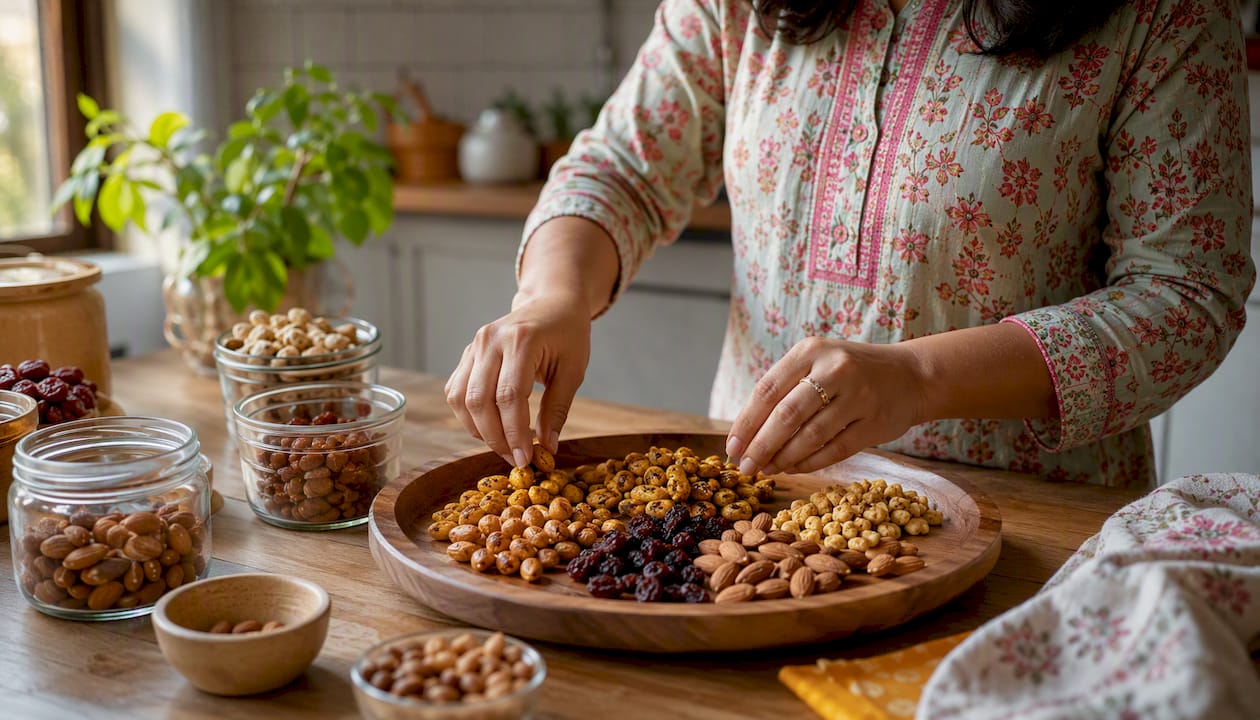
Use this mindful snacking habits checklist to eat with more awareness, stop grazing, and take back control of your portions — one snack at a time.
[ ] Check your hunger first (stomach growling? energy dip? or just boredom?)
[ ] Set a snack time and stick to it — no desk-grazing between sessions
[ ] Plate your snack in a bowl or on a small dish, never eat from the bag
[ ] Measure or eyeball a single portion before you sit down
[ ] Pair protein + healthy fat + fiber for staying power
[ ] Put your phone away and remove other distractions
[ ] Take three slow breaths before your first bite
[ ] Chew slowly, notice the flavor and texture of each bite
[ ] Pause halfway through and check: still hungry or just finishing out of habit?
[ ] Log the snack: time, hunger level, mood, portion
[ ] Store leftovers immediately so you’re not tempted to keep picking
[ ] Reflect for 30 seconds: did that snack satisfy you?
Use this list at your desk, while traveling, during late-night snack moments, or any time you feel the urge to graze. One mindful snack a day is a great place to start.
Key Takeaways
Pairing a consistent mindful snacking checklist with balanced snack combos and simple mindfulness techniques is the most practical way to reduce grazing, control portions, and enjoy your food more.
Point | Details |
Plate every snack | Use a bowl or small dish every time — never eat from the bag or container. |
Balance your combo | Pair protein + healthy fat + fiber to increase satiety and prevent energy crashes. |
Use the 3-breath pause | Three slow breaths before eating interrupts autopilot snacking and helps you check real hunger. |
Track time, hunger, and emotion | A simple log reveals patterns and makes mindful habits stick faster. |
Desimunchiess fits the plan | Home-style roasted chana, atta biscuits, and traditional snacks pair naturally with the balanced-combo approach. |
Table of Contents
Why does mindful snacking actually help you eat better?
Mindful snacking works by slowing down automatic eating. When you pause and check in before reaching for a snack, you interrupt the grab-and-go reflex that leads to overeating. The Harvard T.H. Chan Nutrition Source describes savoring, modest portions, and eating without distractions as core practices that help people recognize fullness and reduce overeating.
The benefits show up fast. Most people notice three changes within the first week:
Less overeating. Plating your snack before eating, as recommended by the CDC, reduces mindless consumption because you see exactly how much you’re having.
Steadier energy. Pairing protein, fat, and fiber slows glucose absorption, which smooths out the energy spikes and crashes that drive afternoon cravings.
More enjoyment. Slowing down and actually tasting your food makes a smaller portion feel more satisfying.
Clinical research published on PMC shows that mindfulness-based approaches have shown promise in reducing emotional-eating behaviors, though results vary by study design and population. The takeaway: even small, consistent awareness habits move the needle.
Mindful snacking isn’t about restriction. It’s about intention. Enjoying a treat in a controlled portion, with full attention, beats eating half a bag on autopilot every time.
How do you plan snack moments and stock a mindful pantry?
Your environment does most of the work. If the right snacks are visible and the less-healthy ones are tucked away, you’ll make better choices without relying on willpower. The CDC advises storing less-healthy foods out of sight and keeping healthier options at eye level to cut impulsive consumption. That one shelf swap is worth more than any diet plan.
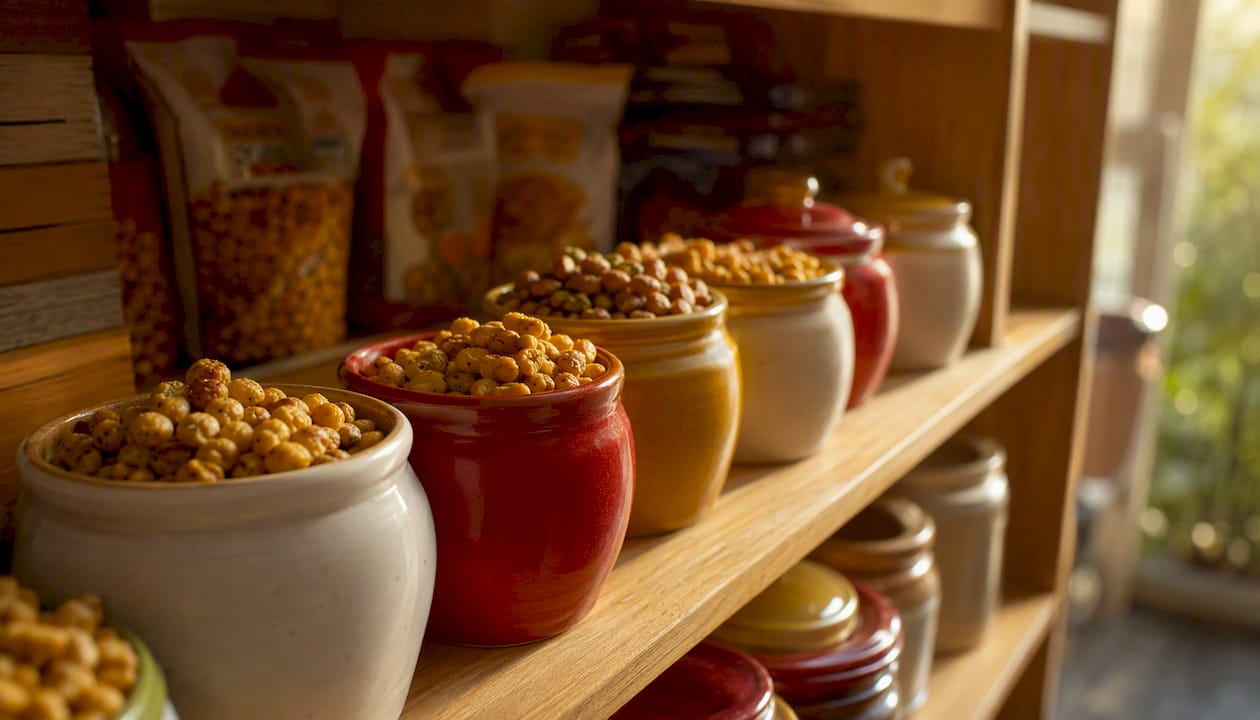
Set two snack windows per day — mid-morning and mid-afternoon work well for most people. Scheduling snacks prevents the extreme hunger that leads to rapid overeating, a pattern the Harvard Nutrition Source flags as a common trigger. Skipping snacks to “save calories” often backfires by the next meal.
Stock these pantry staples for a mindful-snacking setup:
Whole fruits (apples, bananas, clementines) — grab-and-go ready
Raw or roasted chana — high protein, satisfying crunch
Plain Greek yogurt or plain dairy yogurt
A small handful of mixed nuts or nut butter packets
Whole-grain crackers (check the label: fiber first, low added sugar)
Fresh cut vegetables (carrots, celery, cucumber) pre-portioned in containers
Minimally processed snacks with short ingredient lists
Watch for the health-halo effect: foods marketed as “healthy” can still be high in added sugars or fats. Always check the serving size and nutrition facts panel, not just the front of the package, as Harvard Health notes.
Pro Tip: Spend 15 minutes on Sunday batch-portioning snacks into small reusable containers or zip-lock bags. Label each one with the portion size. When a craving hits on a busy Tuesday, you grab a ready pack instead of opening a full bag.
What portion-control tactics actually work in real life?
Simple portioning rules reduce intake without making you feel deprived. The key is removing the decision from the moment of hunger, when your judgment is at its weakest.
Concrete tactics to use right now:
Plate it first. Pour or scoop your snack onto a small plate or bowl before eating. Never eat directly from a large bag or container.
Use single-serve containers. Pre-pack snacks into small containers (4–6 oz works well for most options) so the portion is already decided.
Measure once, memorize the look. Weigh or measure a portion once so you can eyeball it accurately going forward.
Use visual cues when you’re away from home:
One closed fist is a useful visual estimate of about one cup, suitable for foods like popcorn, berries, and cereal
One cupped palm is a useful visual estimate for a serving of nuts or seeds
One thumb can be used as a visual guide for about one tablespoon of foods like nut butter, hummus, or cheese
Two cupped hands can roughly represent one serving of raw vegetables.
These hand-based guides are especially useful at parties, on planes, or anywhere you can’t weigh food. They’re not perfect, but they’re far better than eating until the bag is empty.
Practical portioning behaviors like plating, pre-portioning, and using small containers are consistently recommended by public health authorities as the most reliable way to reduce intake without counting calories.
The CDC’s guidance on healthy snacking reinforces this: putting snacks in a bowl and keeping less-healthy options out of sight are two of the highest-impact changes you can make to your snacking environment.
How do you build a balanced snack that actually keeps you full?
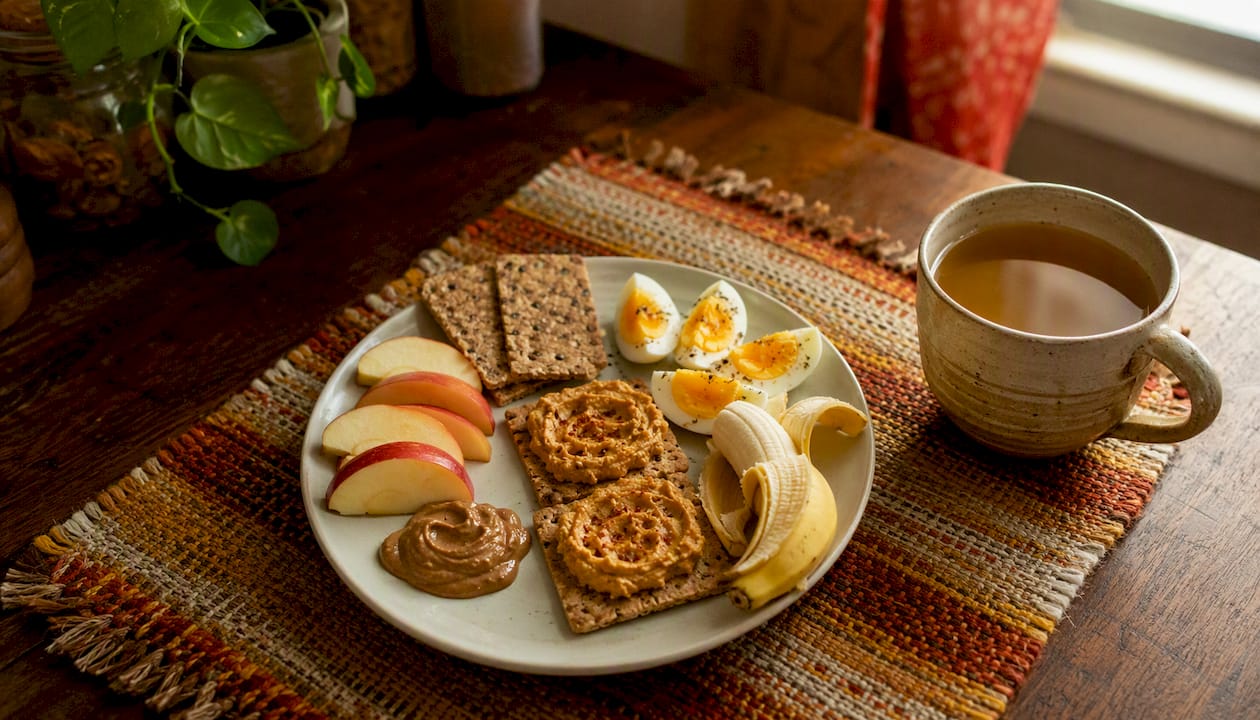
The rule is simple: pair protein + healthy fat + fiber or complex carbohydrate. Harvard Health explains that this combination increases satiety and helps prevent the blood sugar spikes that trigger more cravings 30 minutes later. A handful of crackers alone won’t hold you; add nut butter and a piece of fruit, and you’ve got a snack that lasts two to three hours.
Ready-to-use snack pairings:
Apple slices + 1 tbsp almond butter + a small handful of walnuts
Plain Greek yogurt + berries + a drizzle of honey
Whole-grain crackers + hummus + cucumber slices
Roasted chana + a small piece of fruit
Hard-boiled egg + whole-grain toast + avocado
Celery sticks + peanut butter + raisins
Cottage cheese + cherry tomatoes + whole-grain crackers
Banana + a small handful of mixed nuts
Atta biscuits + a thin spread of nut butter + sliced banana
String cheese + an apple + a few whole-grain crackers
For better-for-you snack ideas that fit these combos, traditional whole-food snacks often outperform packaged options on both flavor and nutrition.
Category | Quick Assembly | Satiety | Portability |
Protein + fruit | Apple + nut butter | High | Easy |
Protein + veg | Egg + crackers + tomato | High | Moderate |
Grain + fat | Whole-grain crackers + hummus | Moderate | Easy |
Legume + fruit | Roasted chana + banana | High | Very easy |
Which mindfulness techniques work best during a snack?
A 60–90 second routine before and during your snack breaks the autopilot eating loop. You don’t need a meditation cushion. You need 90 seconds and a willingness to slow down.
1-minute savoring script (use before your first bite):
Look at your snack. Notice the colors, shapes, and textures.
Smell it. Take one slow breath in through your nose.
Take a small first bite. Chew slowly and count to 10.
Notice: what flavors come through? Is it sweet, salty, crunchy, creamy?
Swallow, pause for three seconds, then take your next bite.
The Harvard Nutrition Source confirms that focusing on smell, texture, and taste slows intake and increases satisfaction from smaller portions.
3-breath pause (use when a craving hits unexpectedly):
Stop. Put the snack down or step away from the kitchen.
Breathe in slowly for four counts, hold for two, out for four.
Repeat twice more.
Ask yourself: “Am I physically hungry, or is this stress/boredom?”
Research on PMC shows that short breathing pauses are effective micro-interventions for interrupting automatic snacking.
Decentering line (use when a craving feels urgent):
Say to yourself: “This craving is a wave. It will peak and pass in a few minutes. I don’t have to act on it right now.”
Psychology Today summarizes research showing that decentering — viewing cravings as temporary thoughts rather than commands — reduces emotional eating when paired with mindfulness. The good news: you can learn this technique without a full meditation practice.
Start with one mindful snack per day. Apply the savoring script to your mid-afternoon snack for one week before adding the other techniques.
Pro Tip: Set a phone reminder that says “Snack mindfully?” at your usual snack time. That single prompt is often enough to pause before reaching for food.
How do you track progress and handle stress or boredom snacking?
Simple tracking increases awareness and reveals patterns you’d never notice otherwise. You don’t need an app. A notes file or a small notebook works fine.
Mini tracking template:
Field | What to log |
Time | When did you snack? |
Hunger rating | 1 (not hungry) to 5 (very hungry) |
Emotion | Calm, stressed, bored, tired, happy |
Portion | What you ate and roughly how much |
Notes | Did it satisfy you? Any triggers? |
Example log entry (Day 3):3:15 PM. Hunger: 3. Emotion: stressed from a work call. Portion: one handful of roasted chana + apple. Notes: felt satisfied after 10 minutes. Noticed I wanted more but wasn’t actually hungry.
Common obstacles and quick fixes:
Stress snacking: Pause, use the 3-breath technique, then check your hunger rating. Johns Hopkins Medicine recommends preparing portioned snacks in advance and using a food journal to identify triggers.
Boredom eating: Ask “Would I eat an apple right now?” If no, you’re not hungry — find a two-minute distraction (walk, stretch, drink water).
Social settings: Pre-eat a small balanced snack before a party so you arrive less hungry. Use the visual portion cues from the checklist.
Skipping meals: Skipping lunch almost guarantees overeating at your afternoon snack. Scheduled meals protect your snack portions.
Late-night snacking: If hunger is real (rating 3+), choose protein + fat (yogurt, a small handful of nuts). If it’s habit, use the decentering line.
For natural craving-control strategies that complement this tracking habit, behavioral tactics work best when paired with a stocked pantry. If emotional eating feels persistent and hard to manage on your own, speaking with a registered dietitian or therapist is a practical next step.
A copyable checklist and 1-week micro-plan you can start today
Print this or paste it into your notes app. Check off each item at every snack moment.
Mindful snacking checklist (per snack):
[ ] Am I physically hungry? (Rate 1–5)
[ ] Is this a scheduled snack time?
[ ] Did I plate my snack in a bowl or on a dish?
[ ] Is my portion measured or visually controlled?
[ ] Does my snack include protein + fat + fiber?
[ ] Phone away, screen off, distractions removed?
[ ] Did I take three breaths before eating?
[ ] Am I eating slowly and noticing the flavors?
[ ] Did I pause halfway to check fullness?
[ ] Did I log the snack (time, hunger, emotion, portion)?
1-week micro-plan:
Day | Snack suggestion | Habit goal |
Day 1 | Apple + almond butter | Practice the 1-minute savoring script |
Day 2 | Roasted chana + banana | Use the 3-breath pause before eating |
Day 3 | Greek yogurt + berries | Log hunger rating and emotion |
Day 4 | Whole-grain crackers + hummus + cucumber | Plate the snack, no phone |
Day 5 | Hard-boiled egg + fruit | Try the decentering line if a craving hits |
Day 6 | Atta biscuits + nut butter + banana | Batch-portion tomorrow’s snacks tonight |
Day 7 | Your choice from the pairings list | Full checklist, all 10 steps |
Day 1 log example: 10:30 AM. Hunger: 4. Emotion: calm. Apple + 1 tbsp almond butter on a small plate. Ate slowly, noticed the sweetness. Satisfied after 10 minutes. No urge to keep eating.
Day 4 log example: 3:00 PM. Hunger: 3. Emotion: slightly stressed. Crackers + hummus + cucumber on a plate. Used the savoring script. Noticed I wanted more crackers but checked in and realized I was full. Stopped.
The habit that changed how we think about snacking
For a long time, late-night snacking felt like a willpower problem. The kitchen called, the bag came out, and half an hour later there was nothing left and no real memory of eating it. Sound familiar?
The shift came from one tiny change: plating the snack first. Just putting a handful of something on a small dish instead of carrying the bag to the couch. That single step created a pause. The pause created a choice. And the choice, over time, became a habit.
The lesson isn’t that snacking is bad. It’s that snacking on autopilot is where the trouble lives. One mindful snack a day, using the checklist above, is genuinely enough to start rewiring that pattern. You don’t need to overhaul your diet. You need 90 seconds of attention and a small bowl.
Desimunchiess makes mindful snacking easier to enjoy
Finding snacks that fit the protein + fat + fiber formula is easier when the snack itself is made with real ingredients and real care. Desimunchiess offers freshly made, home-style Indian snacks — roasted chana, atta biscuits, traditional cookies, and more — crafted from authentic recipes with no mass-production shortcuts. These are snacks you can portion into a small bowl, pair with fruit or yogurt, and actually savor.
Every snack we make is built for people who care about what they eat and want something that tastes like it came from someone’s kitchen, not a factory floor. If you’re building a mindful snack pantry, our Indian snacks online are a great place to start. Browse the full range and find your next favorite snack moment.
Sources
This article is general information, not a substitute for advice from a qualified doctor. Consult a qualified healthcare professional about your own circumstances before acting on anything here.
Recommended
Comments