
Discover North vs South Indian Snacks: A Bold Guide

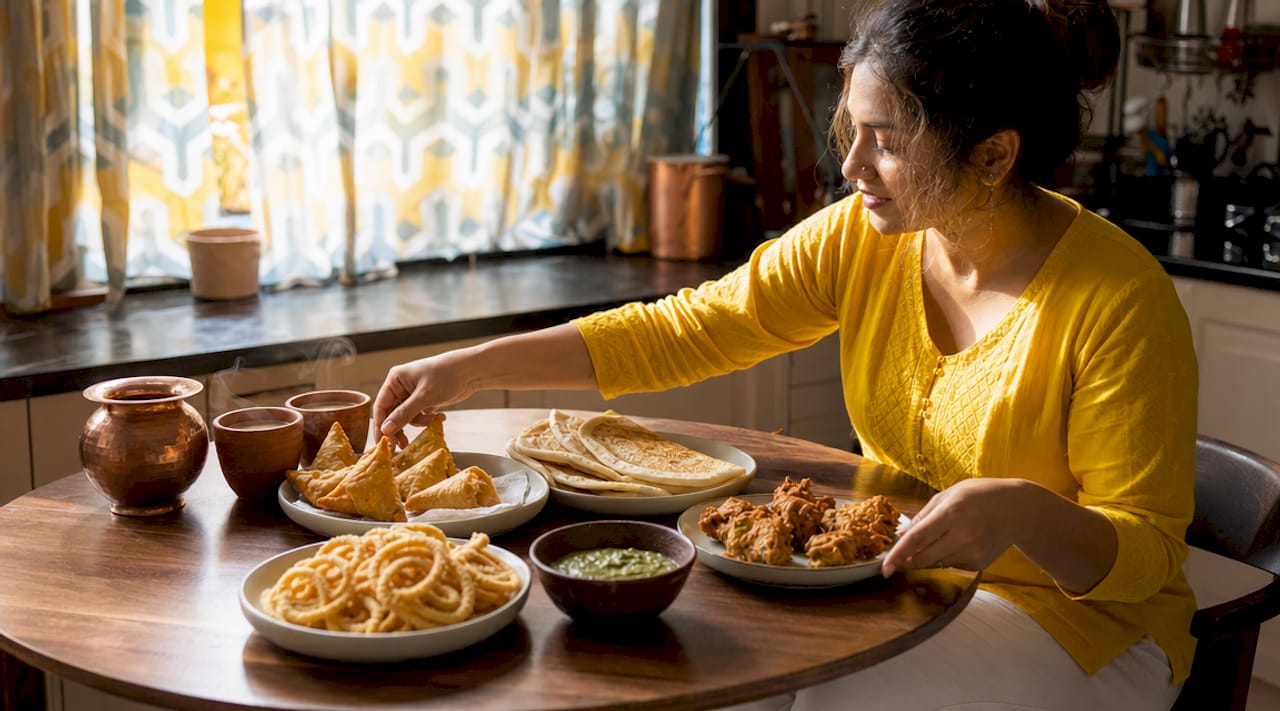
North Indian snacks and South Indian snacks represent two entirely distinct culinary traditions, shaped by different climates, crops, and centuries of regional cooking practice. When you discover north vs south Indian snacks side by side, the contrast is immediate. One tradition leans on wheat, dairy, and warming spices. The other builds flavor from rice, lentils, coconut, and fermentation. Both are extraordinary. Understanding what separates them makes every bite more meaningful. At Desimunchiess, we believe snacking is never just about hunger. It’s about knowing where your food comes from and why it tastes the way it does.
What are the main ingredient differences between North and South Indian snacks?
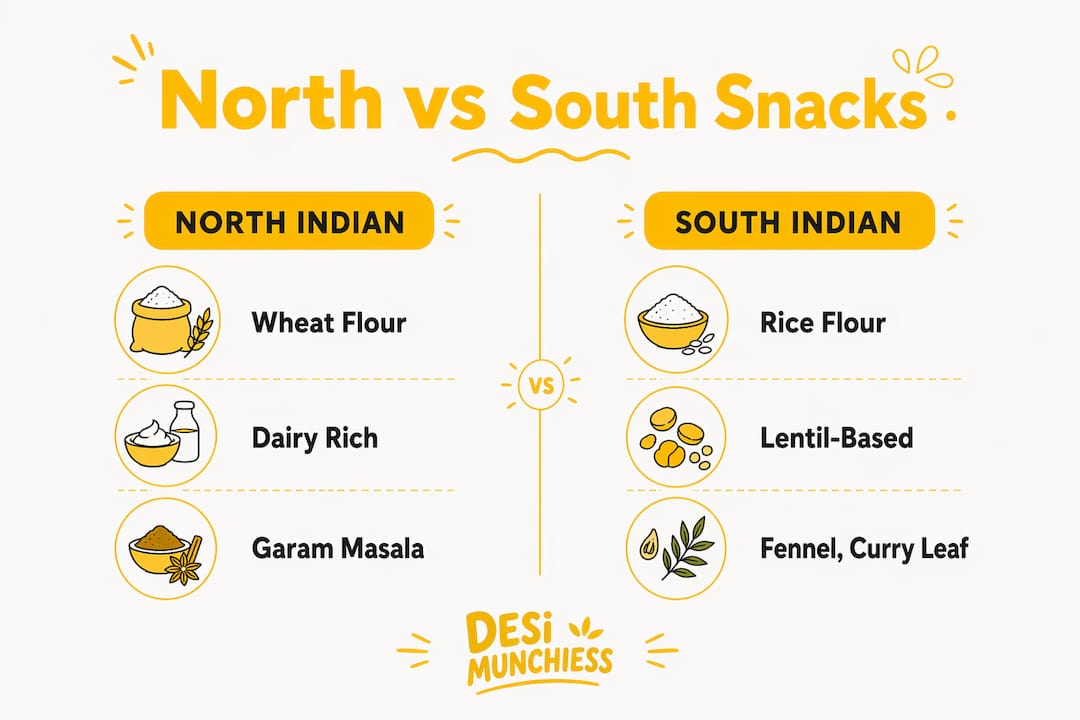
North Indian cuisine predominantly relies on wheat, dairy, and paneer, while South Indian cuisine builds its snacks from rice, lentils, coconut, and tamarind. This single distinction explains most of the popular Indian snack differences you’ll notice when tasting across regions. Wheat flour gives North Indian snacks like samosas and kachori their dense, flaky shells. Rice flour gives South Indian murukku its signature crunch and lightness.
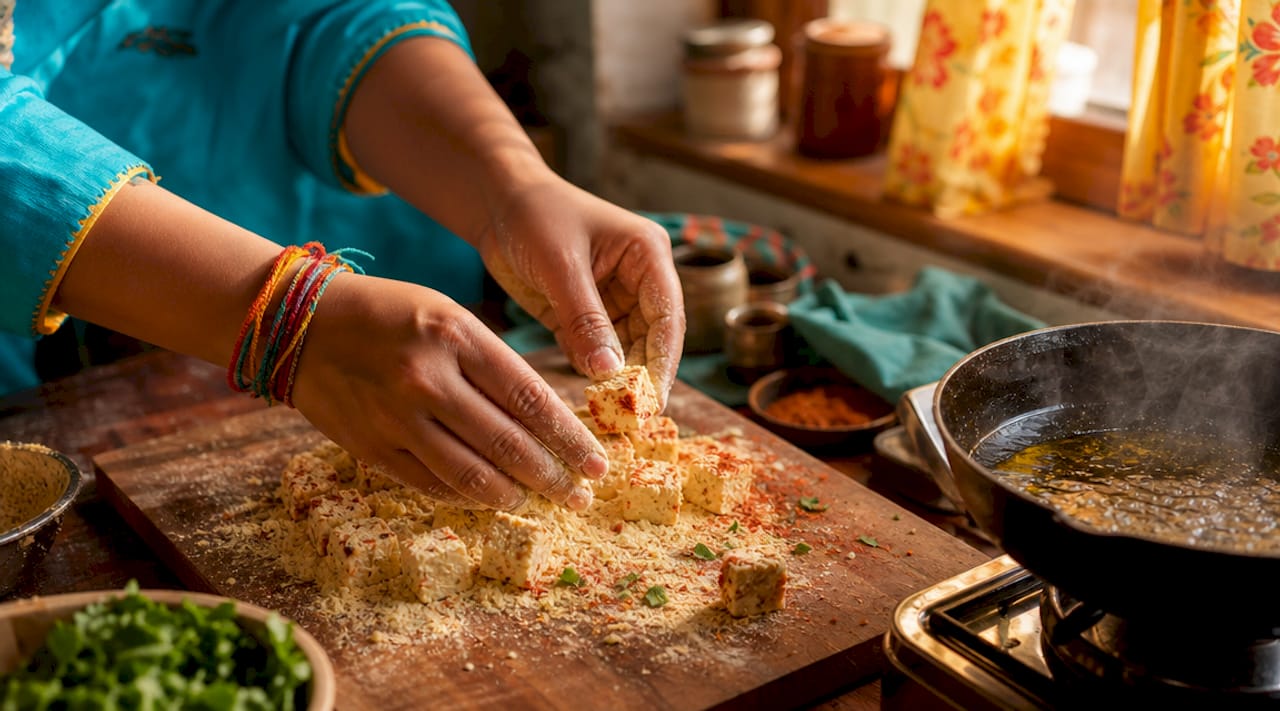
Dairy plays a starring role up north. Paneer pakora, for example, wraps fresh cottage cheese in a spiced chickpea batter before frying. Yogurt appears in marinades and dipping chutneys. Ghee adds richness to everything from fried snacks to baked ones. Down south, coconut replaces dairy as the fat of choice, appearing in chutneys, batters, and coatings. Tamarind delivers the sharp tang that defines so many South Indian snack recipes.
Ingredient | North Indian snacks | South Indian snacks |
Primary flour | Wheat (maida, atta) | Rice flour, urad dal flour |
Fat source | Ghee, butter, yogurt | Coconut oil, coconut flesh |
Protein base | Paneer, chickpea flour | Lentils (chana dal, urad dal) |
Signature flavor agent | Garam masala, cumin | Tamarind, curry leaves, mustard seeds |
Texture method | Frying, baking | Steaming, frying, fermentation |
Geography drives these choices directly. The wheat belt of Punjab, Uttar Pradesh, and Rajasthan produces abundant grain for North Indian cooking. The coastal and tropical climates of Tamil Nadu, Kerala, Karnataka, and Andhra Pradesh grow rice, coconuts, and lentils in abundance. Snacks are never accidental. They reflect what the land provides.
How do cooking techniques vary between North and South Indian snack preparations?
Cooking method is where the two traditions diverge most dramatically. North Indian cooking favors tandoor baking and slow simmering, while South Indian cooking emphasizes steaming and fermentation. These are not interchangeable approaches. Each method produces textures and flavors that the other simply cannot replicate.
South Indian snack recipes depend heavily on fermentation. Idli and dosa batter ferments overnight, developing a mild sourness and a light, airy structure that steaming then locks in. This process requires patience but no special equipment. The result is a snack that is simultaneously soft, tangy, and deeply satisfying. Murukku, by contrast, skips fermentation entirely but demands precise preparation steps.
Here are the key preparation steps for authentic murukku, one of the best Indian street snacks from the South:
Sieve the rice flour and urad dal flour thoroughly to remove coarse grains. Sieving prevents murukku from bursting in hot oil by eliminating trapped air pockets.
Rub softened butter or ghee into the dry flour until the mixture resembles breadcrumbs. Shortening by rubbing ghee into flour creates a light, crispy texture rather than a dense, hard one.
Add sesame seeds, cumin, and salt, then mix in water gradually to form a firm dough.
Press the dough through a murukku press directly into hot oil at 350°F (175°C).
Fry until golden and drain on paper towels. Cool completely before storing.
North Indian snack preparation has its own technical demands. Whisking batter by hand aerates lentil-based snacks like Ram Laddu, creating a fluffy texture rather than a dense one. The tandoor, a clay oven reaching temperatures above 900°F, produces the char and smokiness that defines North Indian bread-based snacks. Most home cooks substitute a cast iron skillet or a very hot oven, but the principle of high, dry heat remains the same.
Pro Tip: When frying North Indian snacks like masala sabji pakora, keep your oil between 325°F and 350°F. Too hot and the outside burns before the inside cooks. Too cool and the snack absorbs excess oil and turns greasy.
What flavor profiles and spice uses distinguish North Indian snacks from South Indian snacks?
North Indian snacks provide comfort through richness, smoke, and bread-based elements, while South Indian snacks energize through rice, coconut, tangy flavors, and spices. This contrast is the clearest way to understand what are South Indian snacks versus their northern counterparts at a sensory level. One warms you from the inside. The other wakes you up.
North Indian spice blends tend to be layered and aromatic. Garam masala combines cinnamon, cardamom, cloves, and black pepper into a warming blend that appears in kachori fillings, pakora batters, and chaat masala. Cumin, both whole and ground, adds an earthy depth. Amchur (dried mango powder) delivers a gentle sourness without the sharpness of tamarind.
South Indian spice use is bolder and more direct. Mustard seeds pop in hot oil at the start of tempering, releasing a nutty, slightly bitter flavor that coats everything it touches. Curry leaves add a citrusy, herbal note that has no real substitute. Black pepper, used generously in snacks like masala vada, delivers a clean, sharp heat that differs entirely from the slow burn of chili powder.
Common spices by region and their typical use in snacks:
Garam masala (North): used in samosa and kachori fillings, chaat seasoning
Cumin seeds (North): whole seeds in dough, ground in chutneys and batters
Amchur (North): sprinkled on chaat, mixed into pakora batter for sourness
Mustard seeds (South): tempered in oil for idli accompaniments and vada batters
Curry leaves (South): fried in oil for murukku dough and masala vada
Tamarind (South): used in chutneys, dipping sauces, and batter souring
Black pepper (South): ground into masala vada for sharp, direct heat
The masala vada is a perfect case study. Masala vada requires a coarse grind of soaked chana dal with fennel, coriander seeds, and curry leaves to achieve its signature crunch. Compare that to a kachori, where the filling is a smooth, spiced paste of lentils or peas wrapped in a flaky wheat shell. Both are fried. Both are spiced. But they taste nothing alike.
What are popular North Indian versus South Indian snacks?
The snack lists from each region read like a culinary atlas. North Indian snack varieties include samosa, kachori, paneer pakora, aloo bhujia, Ram Laddu, chaat papdi, and namak para. South Indian snacks include murukku, idli, dosa, masala vada, medu vada, and banana chips. Each one carries the fingerprint of its region in every ingredient and every step of preparation.
Ram Laddu originated from Uttar Pradesh migrants to Delhi, illustrating how street snacks travel and adapt through migration. What began as a simple lentil fritter became a Delhi street food institution, served with grated radish and green chutney. That evolution tells you something important: North Indian snack varieties are deeply connected to movement, trade routes, and urban street culture.
South Indian snacks carry a different kind of story. Idli and dosa are ancient preparations, with references to fermented rice cakes appearing in Tamil literature from the 10th century. Murukku is tied to festivals and family kitchens, made in large batches during Diwali and stored in tins for weeks. These snacks are about preservation, ritual, and community.
Snack | Region | Key ingredient | Cooking method | Typical serving |
Samosa | North India | Wheat flour, potato | Deep fried | With mint chutney |
Kachori | North India | Maida, lentil filling | Deep fried | With tamarind chutney |
Paneer pakora | North India | Paneer, chickpea batter | Deep fried | With green chutney |
North India | Potato, besan | Deep fried | As a snack or topping | |
Murukku | South India | Rice flour, urad dal | Deep fried | Plain or with coconut chutney |
Masala vada | South India | Chana dal, curry leaves | Deep fried | With sambar or chutney |
Idli | South India | Fermented rice and lentil | Steamed | With sambar and coconut chutney |
Dosa | South India | Fermented rice batter | Pan fried | With potato filling and chutney |
How to experience and enjoy North and South Indian snacks at home
The best way to appreciate both traditions is to taste them side by side. Set up a small tasting spread with one North Indian snack and one South Indian snack, paired with their traditional accompaniments. A samosa with mint chutney next to a masala vada with coconut chutney gives you the full contrast in a single sitting.
The 4:00 PM chai time ritual unites regionally diverse Indian snacks, including North Indian samosas and South Indian murukku, into one shared cultural moment. Brew a strong cup of masala chai with ginger and cardamom, and pair it with roasted chana for a North Indian pairing or with murukku for a South Indian one. Both work beautifully. The spiced tea cuts through the richness of fried snacks and amplifies the aromatic spices in both.
For home preparation, start with the simpler recipes before attempting fermented batters or tandoor-style cooking. Chaat papdi, available ready-made, requires no cooking at all. Just top with yogurt, tamarind chutney, and chaat masala for an instant North Indian snack experience. For South Indian flavors at home, try a store-bought murukku alongside a fresh coconut chutney you blend yourself.
Pro Tip: When making fermented South Indian batters at home, place the batter in a warm oven (just the oven light on, no heat) overnight. This mimics the warm, humid climate of South India and produces a reliable ferment even in cooler American kitchens.
Key takeaways
North Indian snacks and South Indian snacks are defined by their ingredients, cooking methods, and spice philosophies, making each tradition a distinct and rewarding culinary experience.
Point | Details |
Ingredient divide | North Indian snacks use wheat and dairy; South Indian snacks rely on rice, lentils, and coconut. |
Cooking method contrast | North India favors frying and tandoor; South India prioritizes steaming and fermentation. |
Flavor identity | North Indian snacks are rich and warming; South Indian snacks are tangy, spicy, and vibrant. |
Technique precision | Sieving flour and rubbing in ghee are non-negotiable steps for authentic South Indian murukku. |
Cultural pairing | Chai time at 4:00 PM is the universal moment when snacks from both regions come together. |
Why I think most people only scratch the surface of Indian snack culture
Most food lovers try a samosa once and feel like they’ve experienced North Indian snacking. They haven’t. The samosa is the entry point, not the destination. The real depth lives in snacks like Ram Laddu, where the texture depends entirely on how long you whisk the batter by hand, or in a perfectly made kachori from Rajasthan, where the filling is slow-cooked with five different spices before it ever touches dough.
South Indian snacks get even less credit outside their home region. Murukku is often dismissed as “just a rice cracker,” but the technique behind it is genuinely demanding. The sieving, the shortening, the oil temperature, the pressing. Every step matters. When you eat a murukku that was made correctly, you taste the care in it.
What I find most interesting is how both traditions use the same basic act of frying but arrive at completely different results. A North Indian pakora is soft inside, spiced throughout, and meant to be eaten hot. A South Indian murukku is crispy all the way through, subtly spiced, and designed to last for weeks. Same technique. Opposite outcomes. That’s the beauty of regional cooking.
My honest recommendation: don’t pick a favorite. Eat both. Pair them with chai. Learn one recipe from each tradition. The more you understand the “why” behind each snack, the more you’ll enjoy every bite.
— Shivam
Try authentic Indian snacks from Desimunchiess
At Desimunchiess, we make snacks the way they were meant to be made. Fresh, bold, and full of love. Whether you’re craving the rich, warming flavors of North India or the tangy, crispy bites of the South, we’ve got something for you. Try our Priniti Punjabi Tadka for a punchy North Indian flavor hit, or grab our Priniti Tasty Nuts for a satisfying, bold snack any time of day. We handcraft every product using traditional recipes and quality ingredients, so you get that home-cooked taste without the hours in the kitchen. Shop the full range at Desimunchiess and taste both traditions for yourself.
FAQ
What is the main difference between North and South Indian snacks?
North Indian snacks are built on wheat, dairy, and warming spices like garam masala and cumin, while South Indian snacks use rice flour, lentils, coconut, and tangy ingredients like tamarind and curry leaves. The cooking methods also differ, with North India favoring frying and tandoor baking and South India relying on steaming and fermentation.
What are some popular South Indian snacks to try first?
Murukku, masala vada, idli, and dosa are the most recognized South Indian snacks and the best starting points for anyone exploring what South Indian snacks taste like. Each one showcases the region’s signature use of rice, lentils, and bold spice tempering.
Can I pair North and South Indian snacks with chai?
Yes. Chai time is a shared cultural ritual across India where snacks from both regions are enjoyed together. Samosas and chaat papdi pair well with masala chai from the North, while murukku and roasted chana work equally well alongside a strong cup of ginger tea.
Why does murukku require sieving the flour before use?
Sieving removes coarse grains and trapped air from rice flour, which prevents murukku from bursting in hot oil during frying. Skipping this step is the most common reason home-made murukku cracks or breaks apart in the pan.
Are North Indian snacks generally richer than South Indian snacks?
North Indian snacks tend to be richer because they use ghee, butter, paneer, and yogurt as core ingredients. South Indian snacks are lighter overall, relying on steaming and fermentation rather than heavy fats, though both traditions include deeply satisfying fried options.
Recommended
Comments