
How to Incorporate Indian Snacks Fusion Recipes at Home

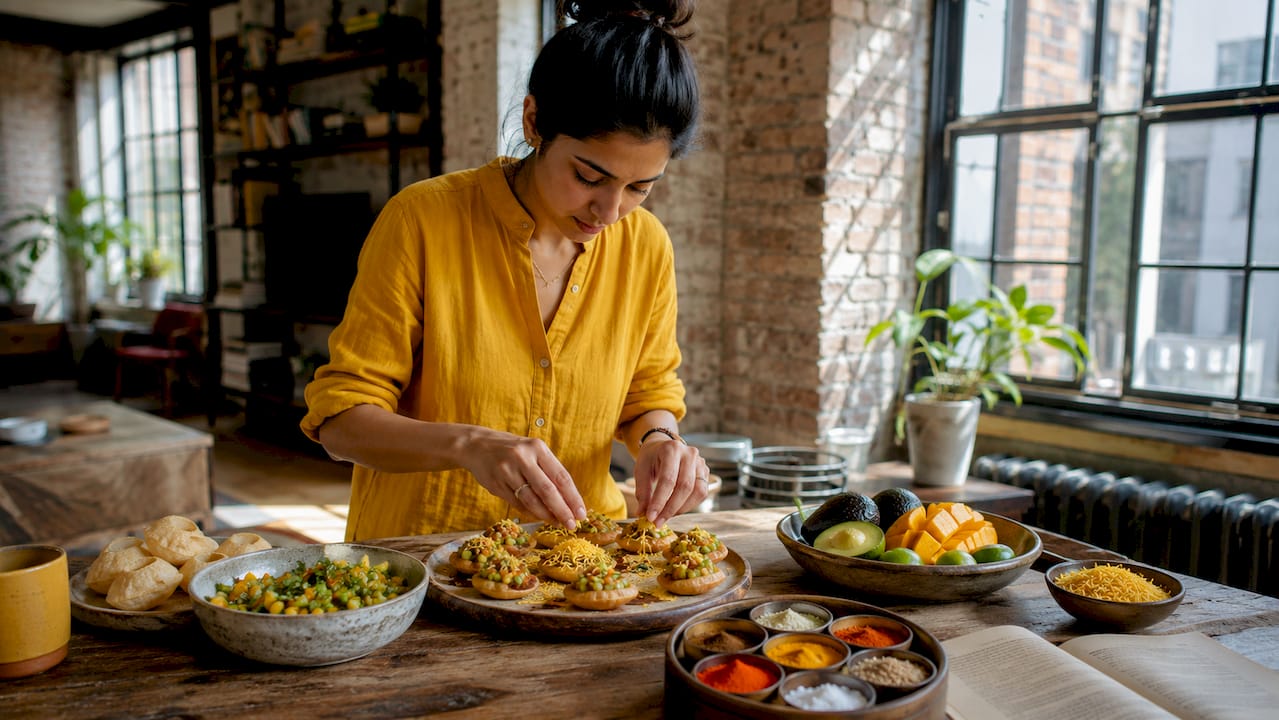
Indian snack fusion is defined as the practice of blending traditional Indian snack formats with global flavors, fillings, and techniques to create entirely new eating experiences. You can incorporate Indian snacks fusion recipes by keeping the iconic textures and structures of classics like sev puri, samosas, and chaat while swapping in ingredients like mango-avocado salsa, hakka noodles, or butter chicken sauce. The results are bold, crowd-pleasing bites that feel both familiar and excitingly new. Success depends on three things: texture control, flavor balance, and smart assembly timing. This guide walks you through every step.
What foundational principles help you fuse Indian snacks with other cuisines?
Texture management is the cornerstone of every successful Indian snack fusion recipe. Lose the crunch and you lose the soul of the dish. Every decision you make, from how you store your bases to when you add your sauces, should protect that crispness.
The single most useful concept here is the moisture budget. Every fusion topping you add carries water. Yogurt, salsa, and chutneys all soften crispy bases over time. Assemble chaat just before eating, use thick chilled yogurt, and add liquids sparingly to stay within your moisture budget.
Flavor balance is the second pillar. Indian snacks already carry bold spice profiles from chaat masala, tamarind, and green chutney. Global additions like avocado, soy sauce, or melted cheese need to complement those flavors, not compete with them. A good rule: add one new flavor layer at a time, taste, then adjust.
The third principle is what culinary writers call “swap the filling, keep the format.” Separating the snack structure from the flavor profile lets you innovate widely while keeping the dish recognizable. A samosa is still a samosa when it holds hakka noodles. A papadum cup is still a papadum cup when it holds spiced black beans.
Here are the core principles to keep in mind before you start:
Keep crispy bases completely dry until the final 60 seconds before serving.
Use thick yogurt whisked with a pinch of salt and sugar, never thin or watery.
Add chutneys in thin swipes rather than generous pours.
Introduce global ingredients in small, controlled portions.
Taste your fusion filling separately before assembling to check spice balance.
Pro Tip: Prep all your toppings and sauces in separate bowls before you start assembling. Speed at the assembly stage is what keeps everything crispy.
Which Indian snacks work best for fusion recipes?
The best Indian snacks for fusion share one quality: a strong structural format that holds fillings or toppings without falling apart. Check out this home cook’s fusion guide for a broader look at which classics translate best.
1. Sev puri with mango-avocado salsa
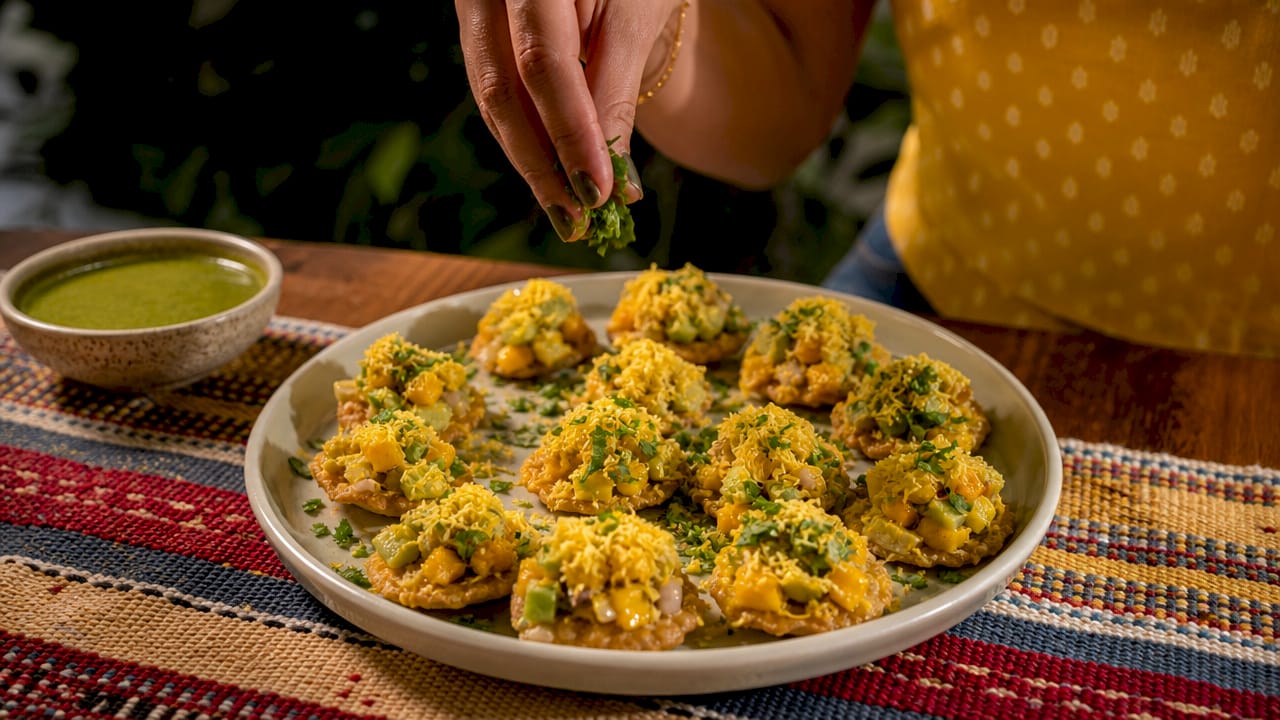
Sev puri is the ideal fusion canvas because its layered assembly already welcomes customization. The classic stack runs potato mixture, green chutney, tamarind-date chutney, optional yogurt, mango-avocado salsa, sev, chaat masala, and fresh coriander. Avocado replaces yogurt cleanly, adding creaminess without extra moisture. Portion control on the salsa is critical. A small spoonful per papdi keeps the crunch intact and lets the tamarind and mango flavors sing together.
2. Indo-Chinese samosas
The samosa wrapper is one of the most forgiving formats in Indian cooking. The Indo-Chinese version keeps the triangular dough shell and swaps the potato filling for stir-fried hakka noodles with cabbage, capsicum, spring onions, soy sauce, vinegar, and green chili sauce. Paneer, chicken, prawn, and cheese variations all work. You can bake or air-fry instead of deep-frying for a lighter result.
3. Papad katori chaat
Papadums microwaved into rigid cup shapes create edible bowls called katoris. Microwave each papad on high for 60 seconds, adding 30 more seconds if needed, then fill with 2–3 tablespoons of spiced chickpeas and serve immediately. The cups hold their shape just long enough for one satisfying serving. Fill them with black bean salsa, roasted corn, or spiced gnocchi for a global twist.
4. Butter chicken nachos
Naan replaces tortilla chips in this Indian-Mexican mashup. Cut naan into triangles, brush with butter chicken sauce, top with shredded cheese, and bake at 400°F for 5–7 minutes. The cheese melts and the sauce thickens while the naan stays crisp underneath. This is a party snack that requires almost no special equipment and delivers maximum impact.
Comparison: Indian snack bases for fusion
Snack base | Best fusion style | Key challenge |
Sev puri papdi | Global toppings and salsas | Moisture from salsa softens sev quickly |
Samosa wrapper | Swapped fillings, any cuisine | Sealing filled wrappers tightly |
Papadum katori | Portable filled cups | Must serve within 2 minutes of filling |
Naan triangles | Indian-Mexican, Indian-Italian | Staying crisp under heavy toppings |
Kurkuri bhindi | Chaat-style assembly | Air-frying timing for even crispness |
Pro Tip: Explore North vs. South Indian snack varieties before you pick your fusion base. Regional snacks offer very different textures and flavor profiles to work with.
How do you prepare Indian snack fusion recipes at home?
Home assembly of fusion snacks follows a clear sequence. Get your bases ready first, your fillings second, and your sauces last. Never reverse that order.
Ingredients and tools for three core fusion recipes
Recipe | Key ingredients | Tools needed |
Sev puri fusion | Papdi, potato, avocado, mango, tamarind chutney, green chutney, sev | Mixing bowls, small spoons |
Indo-Chinese samosa | Samosa dough, hakka noodles, soy sauce, cabbage, capsicum | Wok, rolling pin, air fryer or oven |
Butter chicken nachos | Naan, butter chicken sauce, shredded cheese, cream | Baking sheet, oven at 400°F |
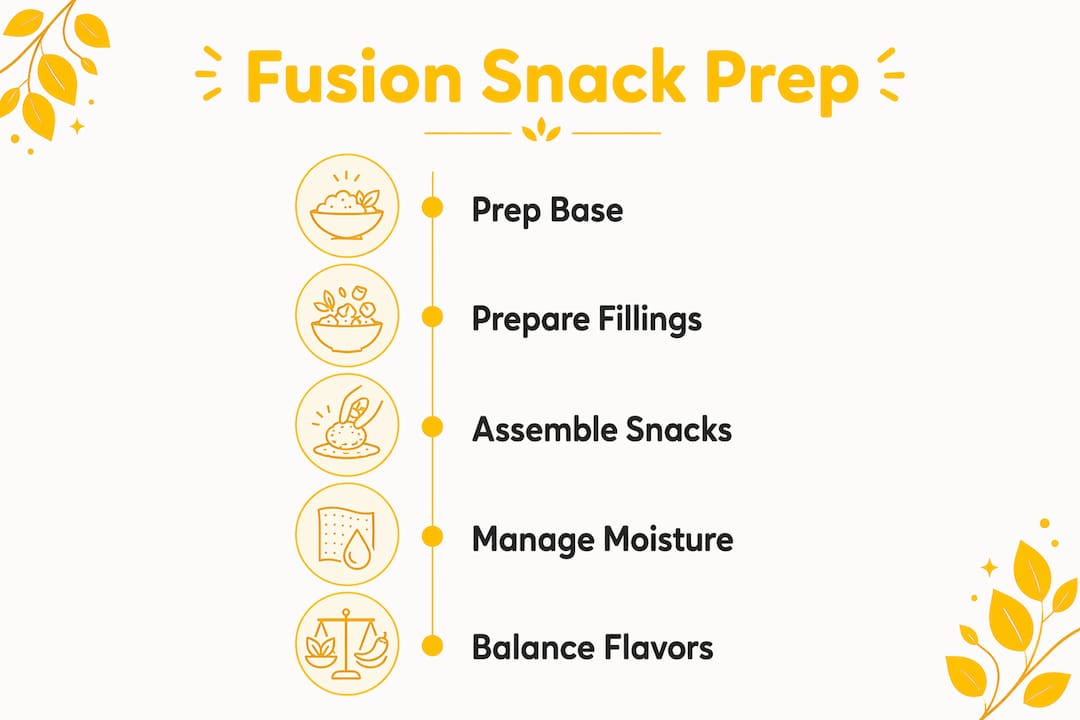
Follow this sequence for any fusion chaat assembly:
Prepare your crispy base (papdi, papadum cup, or air-fried bhindi) and keep it completely dry at room temperature.
Make your filling or topping mixture and refrigerate it until needed.
Whisk thick yogurt with a pinch of salt and sugar. Chill until serving time.
Lay out all sauces and garnishes in separate small bowls.
Assemble one serving at a time. Place the base, add filling, add yogurt in a thin layer, swipe chutneys lightly, add the fusion topping last.
Finish with sev, chaat masala, and fresh coriander. Serve within 60 seconds.
For samosas and nachos, the process differs slightly. Samosa filling should be fully cooked and cooled before wrapping. Warm filling creates steam inside the dough, which leads to soggy pastry. For nachos, baking at 400°F for 5–7 minutes creates the right texture: melted cheese on top, crisp naan underneath.
Common problems and fixes:
Soggy base: You added liquid too early. Assemble faster next time, or switch to a thicker sauce.
Overpowering spice: Add a small amount of cream, avocado, or yogurt to soften the heat.
Filling falling out of samosas: Let the filling cool completely and seal edges with a flour-water paste.
Papadum cups collapsing: Microwave for the full 90 seconds and fill immediately. Do not pre-fill.
Pro Tip: Air-frying samosas at 375°F for 12–15 minutes gives you a crispy shell with far less oil than deep-frying. Flip halfway through for even browning.
What are advanced fusion snack variations worth trying?
Once you have the basics down, the creative possibilities expand quickly. Crispy gnocchi chaat is one of the most surprising fusion builds: golden roasted gnocchi replaces papdi as the base, paired with spiced chickpeas, tamarind-date chutney, green chutney, and optional chili oil. The gnocchi holds its crunch longer than papdi, making it a forgiving option for home cooks who need more assembly time.
Kurkuri bhindi chaat uses air-fried okra as the crunchy base. Slice okra thin, coat with besan and rice flour, and air-fry at 190°C for 12–15 minutes, tossing halfway. Assemble promptly with yogurt, chutneys, chaat masala, and lemon juice. The okra adds an earthy, vegetal note that works beautifully with tangy tamarind.
Here are more advanced ideas to experiment with:
Add a drizzle of mango chili pickle to Indo-Chinese samosas for a sharp, fruity heat contrast.
Build a fusion platter with three different bases (gnocchi, bhindi, papadum cups) and let guests customize their own toppings.
Use roasted chana as a crunchy topping on sev puri instead of sev for a protein-forward variation.
Swap tamarind chutney for a Korean gochujang-tamarind blend to add a smoky, fermented depth.
Finish butter chicken nachos with pickled red onions and fresh jalapeños for a sharper contrast against the rich sauce.
Pro Tip: Build a “sauce bar” when serving fusion snacks at a party. Set out green chutney, tamarind chutney, chili oil, and a creamy yogurt dip. Guests build their own heat levels, and you avoid the soggy-snack problem entirely.
Key takeaways
Successful Indian snack fusion depends on protecting crunch, controlling moisture, and keeping the traditional snack format intact while swapping flavors freely.
Point | Details |
Moisture budget is non-negotiable | Use thick yogurt, thin chutney swipes, and assemble within 60 seconds of serving. |
Swap fillings, keep the format | Change what goes inside a samosa or katori without changing its shape or structure. |
Assemble in the right order | Dry base first, filling second, sauces third, garnish last. Never reverse this. |
Air-frying beats deep-frying for fusion | Air-fried bases stay crispier longer and hold up better under wet toppings. |
Global ingredients need portion control | Small amounts of salsa, cheese, or soy sauce enhance flavor without overwhelming the base. |
What I’ve learned from years of playing with Indian snack fusion
The biggest mistake I see home cooks make is treating fusion as an excuse to pile on toppings. More is not better here. The magic of a great sev puri or samosa lives in restraint. One bold new ingredient, added in the right amount at the right moment, does more than five competing additions.
The second thing I’ve learned is that moisture is the enemy you never see coming. I’ve ruined more than a few chaat platters by prepping too far ahead. Now I treat assembly like a sprint. Everything is ready, everything is cold, and I plate and serve in under a minute. That discipline is what separates a crispy, vibrant fusion snack from a sad, soggy pile.
My personal favorite combination is still the mango-avocado sev puri. The avocado cools the tamarind heat, the mango adds brightness, and the sev gives you that satisfying crunch on every bite. It respects the original and adds something genuinely new. That balance is what good fusion cooking is all about.
If you are just starting out, begin with butter chicken nachos. The format is forgiving, the ingredients are easy to find, and the results are crowd-pleasing every single time. Once you feel confident there, move to chaat-style builds and then to samosa filling swaps. Build your skills in layers, just like the snacks themselves.
— Shivam
Fresh Indian snack ingredients for your fusion kitchen
Good fusion cooking starts with authentic bases. If your chaat papdi is stale or your spices are old, no amount of creative topping will save the dish.
At Desimunchiess, we make freshly prepared, bold-flavored snacks using traditional recipes and handcrafted methods. Our chaat papdi and tikoni mathi are made to stay crispy, which means they hold up beautifully as fusion bases. We also carry pickles, chutneys, and spice-forward snacks that pair naturally with global ingredients. Browse the full range at Desimunchiess and order directly to your door. Fresh ingredients make every fusion recipe taste like it was made with love.
FAQ
What does “Indian snack fusion” mean?
Indian snack fusion means keeping the structure of a traditional Indian snack, like a samosa or sev puri, while replacing or adding fillings and toppings from other cuisines. The goal is a new flavor experience that still feels grounded in the original snack.
How do I keep fusion chaat crispy?
Assemble chaat just before serving and use thick, chilled yogurt with chutneys applied in thin layers. Never pre-assemble chaat more than a minute before eating.
Which Indian snack is easiest to fuse for beginners?
Butter chicken nachos are the easiest starting point. You bake naan triangles with butter chicken sauce and cheese at 400°F for 5–7 minutes, and the result is a crowd-pleasing snack with minimal technique required.
Can I make fusion samosas without deep-frying?
Yes. Air-fry samosas at 375°F for 12–15 minutes, flipping halfway through. The shell turns golden and crispy with far less oil, and the texture holds up well under heavier fusion fillings.
What global ingredients pair best with Indian chaat spices?
Avocado, mango, roasted corn, and gochujang all pair well with tamarind, green chutney, and chaat masala. Each adds a distinct flavor note, creamy, sweet, smoky, or fermented, without clashing with the base spice profile.
Recommended
Comments