
Canned Gulab Jamun Quality: What Actually Makes One Great
- DesiMunchiess

- 2 days ago
- 9 min read
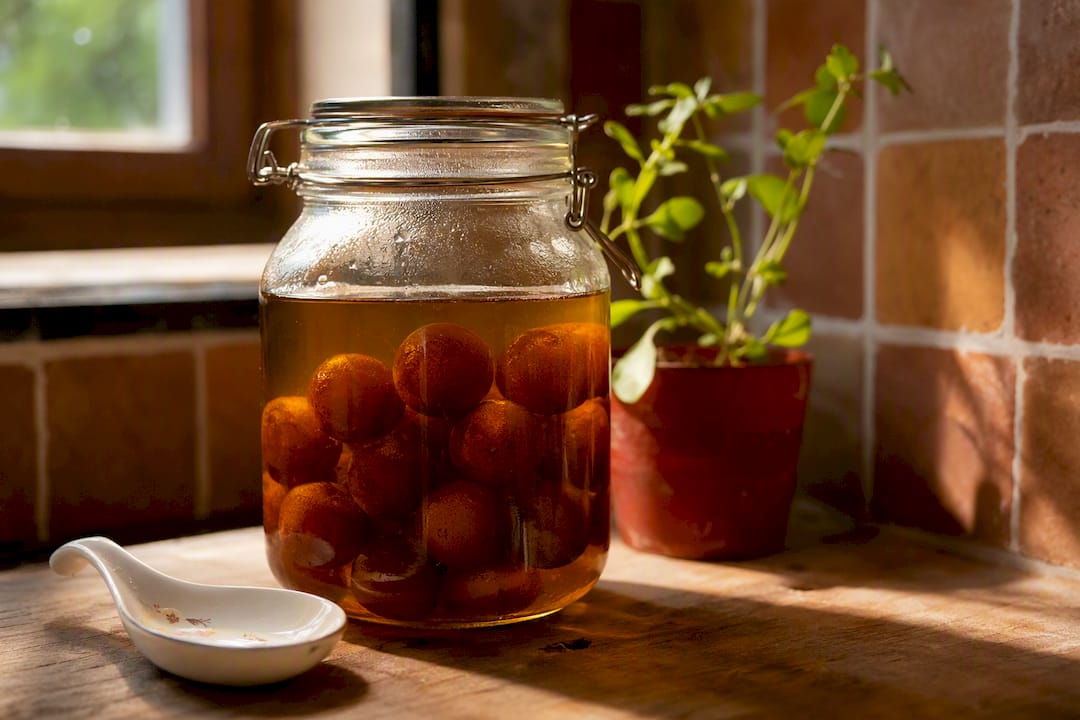
Yes, canned gulab jamun can genuinely deliver homemade-level quality, but only when it’s built on real milk solids (khoa) instead of mostly refined flour, and balanced with syrup that’s neither watery nor cloying. That’s the whole verdict in one sentence. We built Desimunchiess around that exact standard because we got tired of seeing canned versions treated like a compromise instead of a craft.
If you’re standing in front of a shelf of cans or scrolling product pages at midnight craving something sweet and soft, here’s what to check before you buy anything:
Ingredient prominence: Milk solids or khoa should appear early in the ingredient list, not buried behind sugar and flour.
Production or pack date: Fresher cans hold texture better; a jar packed months ago has had more time for syrup separation or over-softening.
Syrup viscosity: Give the can a gentle shake if you can. Syrup that looks thin and runny usually signals under-concentration, while a syrup that clings has the body needed for proper absorption.
Get those three right, and you’re most of the way to a can that tastes like it came from a kitchen, not a factory line.
TL;DR:
The key to high-quality canned gulab jamun is a high ratio of milk solids to flour, with the dairy content near the top of the ingredients list.
Proper syrup concentration between 50 and 70 degrees Brix is essential to ensure full absorption without a dry core or overly sweet taste.
Freshness, packaging date, and storage instructions significantly impact texture, so choose smaller cans with clear dates and minimal preservatives.
Consumer reviews confirm that proper soaking, gentle warming, and authentic ingredient ratios produce canned gulab jamun that tastes close to homemade.
Brands like Desimunchiess prioritize small-batch, khoa-heavy recipes with transparent ingredient lists to meet these scientific quality standards.
Table of Contents
What Determines Good Canned Gulab Jamun Quality?
Three things separate a forgettable can from one that disappears in two servings: the ratio of milk solids to flour, the physical shape and surface of the dumpling, and the syrup it’s swimming in.
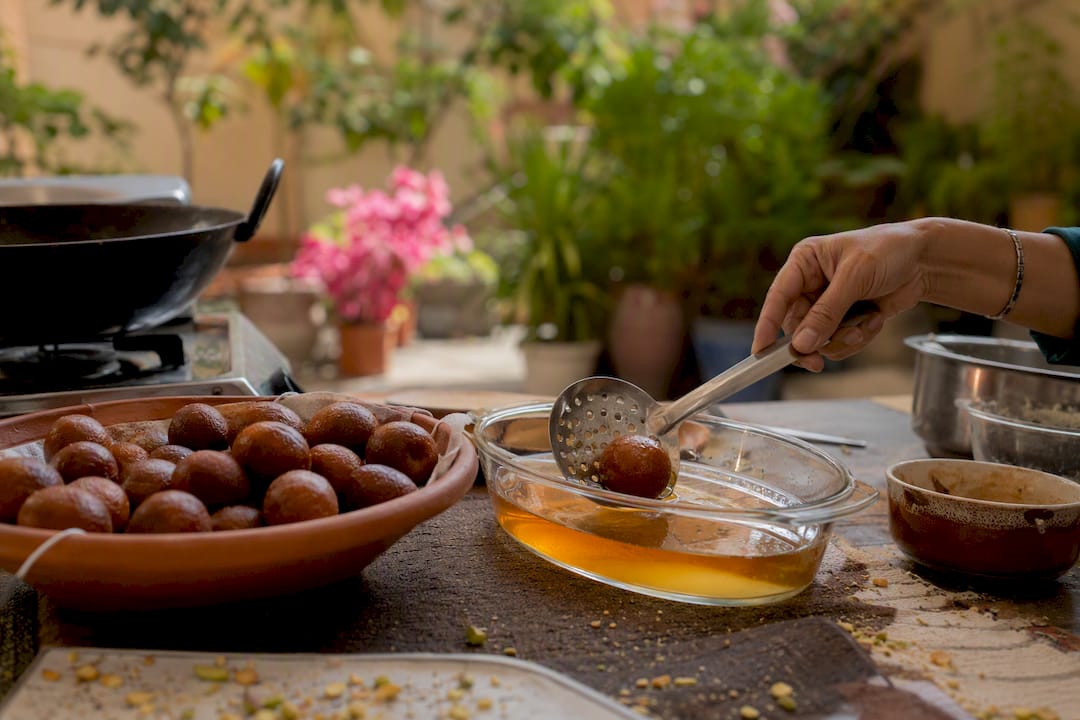
Start with the dough. Traditional gulab jamun uses khoa, milk reduced down until it’s almost a solid, mixed with a small amount of refined flour (maida) as a binder. When manufacturers lean heavily on flour to cut costs, the result is a denser, gummier bite that lacks the faint caramelized dairy flavor real khoa provides. A higher khoa-to-flour ratio produces a richer, more authentic flavor profile, and it’s the single biggest lever separating a premium can from a bargain one.
Texture tells the rest of the story. A well-made piece should show a few consistent traits:
Uniform brown color across the surface, without pale patches that suggest uneven frying.
A smooth, unbroken exterior with no cracks, which indicates the dough held together properly during frying.
A round, even shape, since lopsided pieces often point to inconsistent dough handling.
A soft, faintly granular interior rather than a hard core or an overly mushy center.
Food scientists studying khoa-based sweets have documented these exact markers. High-quality gulab jamun consistently shows a uniform color and soft, granular internal structure that holds together while still absorbing syrup evenly, a balance that’s harder to achieve than it sounds.
Pro Tip: Press a piece gently with the back of a spoon before eating. It should give slightly and spring back, not collapse into mush or resist like a rubber ball.
Syrup concentration is the part most people never think to question, yet it might matter more than anything else. Research on gulab jamun formulation points to a sweet spot of roughly 50 to 70 degrees Brix, a measure of sugar concentration in liquid. Syrup that’s too thin won’t penetrate the dumpling fully, leaving a dry center. Syrup that’s too thick can oversaturate the exterior while the middle stays underdeveloped, or it just tastes like straight sugar water with a dumpling in it.
Processing steps compound all of this. How long the dough fries, how long the fried pieces rest before hitting the syrup, and how long they soak afterward all shape the final microstructure. Heat and frying time actually reshape the protein and fat network inside khoa at a microscopic level, which is why frying and desiccation steps produce such different textures between a rushed commercial batch and one given proper time.
How to Judge Canned Gulab Jamun Quality From the Label
You can eliminate a surprising number of weak options before you ever open the can, just by reading the label the way a food scientist would.
Start with ingredient order. Labels list ingredients by weight, heaviest first, so if “sugar” and “wheat flour” dominate the top of the list while “milk solids,” “khoya,” or “evaporated milk” show up near the bottom (or not at all), you’re likely looking at a flour-heavy version built for shelf life over flavor. The strongest options put a dairy ingredient right up near the top, alongside sugar.
Net weight matters more than most shoppers realize. Larger cans and bulk units often need a longer soak or warming period to bring every piece up to the same texture, since heat and syrup distribute unevenly in bigger containers. If you’re buying for a small household, a smaller can with a faster turnover is usually the safer bet for consistent texture from first bite to last.
A few more checkpoints worth thirty seconds of your time:
Production or pack date: Newer batches tend to have fresher syrup and firmer, more intact pieces.
Shelf life window: A shorter recommended shelf life sometimes signals fewer preservatives and a more natural formulation, though this isn’t universal.
Ingredient list length: Shorter, simpler lists with recognizable ingredients tend to correlate with more traditional recipes.
Storage instructions: Clear guidance on refrigeration after opening suggests the manufacturer is thinking about texture preservation, not just shelf stability.
Pro Tip: If a label lists “milk solids” as a percentage, look for something in the double digits. Products that hide behind vague terms like “dairy blend” without a percentage are usually cutting corners.
None of these checks require tasting anything or trusting marketing copy. They just require reading past the front of the can to the fine print most shoppers skip entirely.
What Do Consumers Actually Say About Canned Gulab Jamun?
Patterns in consumer feedback line up almost perfectly with the food science, which is reassuring if you’re trying to shop smart without a lab.
The praise tends to cluster around a few specific experiences. People consistently highlight softness that holds up without falling apart, a sweetness level that feels balanced rather than overpowering, and a dairy richness that reads as authentic instead of artificial. These reactions almost always trace back to two manufacturing choices: a khoa-forward recipe and adequate soak time before the product ever gets canned. One review of a widely available canned brand noted that the texture held up close to homemade quality specifically because the pieces had been soaked long enough to absorb syrup fully before packaging, rather than relying on the buyer to fix an underdone product at home.
Complaints cluster just as predictably around the opposite failures:
Chalky or gummy centers, usually a sign of too much refined flour or insufficient frying and soak time.
Overly syrupy or cloying sweetness, which points to syrup concentration pushed too high without enough dumpling to balance it.
Inconsistent texture within the same can, where some pieces are soft and others are noticeably firmer, suggesting uneven soaking during processing.
What’s interesting is how directly these complaints map back to the same three variables covered earlier: dough formulation, syrup Brix, and soak duration. A gummy center isn’t bad luck. It’s a formulation choice, usually one made to cut ingredient costs. Authentic production in top-tier gulab jamun sometimes involves soaking for up to 24 hours to reach peak texture, letting syrup penetrate slowly and evenly rather than rushing the process. Brands that skip that patience tend to be the ones showing up in the chalky-center complaints.
Market testing backs this up with real numbers. Evaluations comparing gulab jamun across different brands found measurable variation in moisture, absorbed sugar, and hardness, confirming that “brand quality” isn’t just a vibe. It’s a set of physical properties you can actually measure, and they vary a lot more between products than most shoppers assume.
How to Store and Serve Canned Gulab Jamun for the Best Texture
Canned gulab jamun is fully cooked, so you’re not “finishing” a raw product. You’re waking one up. A few minutes of the right treatment can be the difference between a can that tastes reheated and one that tastes freshly made.
Warm gently with some of the syrup, either on the stovetop over low heat or in short microwave bursts of 15 to 20 seconds. Gentle heat with syrup releases aroma and softens the interior without breaking the pieces down. Avoid high heat or extended microwaving, which can turn the exterior rubbery.
If pieces seem under-soaked or firmer than expected, warm them in syrup, cover the container, and let them rest for 30 to 60 minutes at room temperature. This gives the dumplings time to keep absorbing syrup even after the can has already done most of the work.
After opening, transfer leftovers to an airtight container and refrigerate. Most canned versions stay shelf-stable for months unopened, but once opened, texture starts to shift within a few days, so plan to finish the batch within three to four days for the best bite.
Pro Tip: A pinch of freshly crushed cardamom, a single drop of rosewater, or a scatter of toasted pistachios can lift a good can into something that tastes like it came straight from a family kitchen. Small additions go a long way here.
Why Desimunchiess’ Approach Matches These Quality Markers
Everything in this guide points back to a few unglamorous but decisive choices: enough milk solids, controlled syrup concentration, and patient processing instead of shortcuts. That’s the exact philosophy behind how Desimunchiess approaches every product on the shelf, gulab jamun included.
Our team, working from Shivam’s focus on authentic recipe development, builds recipes the way a home cook would if that home cook also cared about consistency from batch to batch. That means:
Recipes built around traditional khoa proportions rather than flour-heavy shortcuts.
Small-batch, handcrafted production that allows for the kind of soak and rest time larger commercial lines often skip.
Ingredient transparency on every product page, so you can see what’s actually going into what you’re eating before you order.
A canned dessert only earns the word “quality” when you can trace every texture decision back to an ingredient choice, not a cost-cutting shortcut. That’s the standard we hold ourselves to on every product page.
We’re not claiming a lab tested every jar. What we can tell you is that the same principles food scientists point to, milk-solid ratio, syrup balance, adequate soak time, are the ones guiding how we build our recipes in the first place.
What the Research Actually Tells Us About Canned Gulab Jamun
The conventional wisdom treats “canned” as a synonym for “lesser,” and that’s simply not supported by what the food science actually shows. Texture and flavor come down to formulation and process, not the container. A can with the right khoa ratio and proper syrup concentration will outperform a fresh dessert made with mostly flour and rushed frying, every time.
Where most buying guides fall short is stopping at “check the ingredients” without explaining why the order and ratio matter, or what soak time has to do with anything. Ingredient percentages are levers, not trivia. Understanding what each one does lets you predict texture before you ever taste the product.
If you take one thing from this guide, prioritize the dairy-to-flour ratio over price or brand recognition. Everything else, syrup balance, soak time, packaging freshness, tends to follow from a manufacturer that already respects that first ratio.
— Shivam
Where to Find Canned Gulab Jamun Built on These Standards
If you’ve read this far, you already know what separates a forgettable can from one worth keeping in the pantry: real milk solids up front, syrup concentrated enough to soak in properly, and enough production patience to let that soaking actually happen. Desimunchiess builds its canned sweets around exactly that checklist instead of around what’s cheapest to mass-produce.
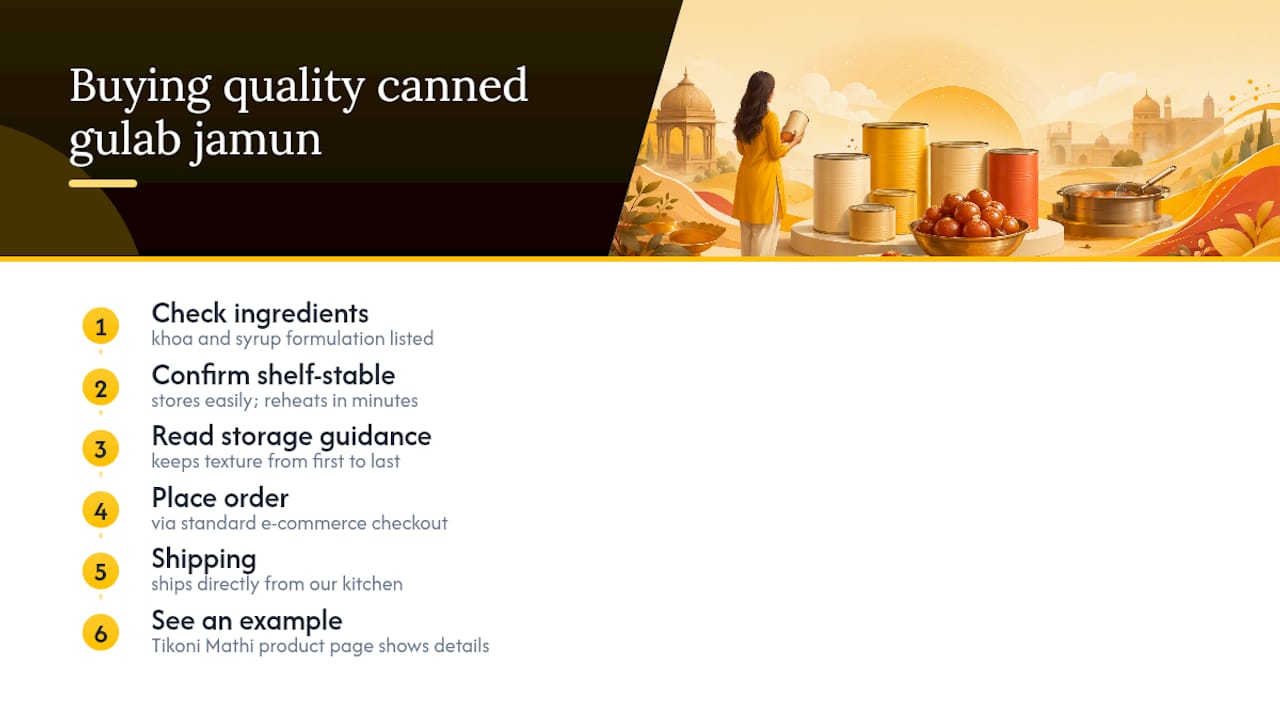
Every product page on our site lists ingredients plainly, so you can confirm the khoa content and syrup formulation before you order, not after you’ve already opened the can. Expect a shelf-stable product that stores easily and reheats in minutes, with clear storage guidance included so the texture holds up from the first piece to the last. Shipping is handled through our standard e-commerce checkout, and orders ship directly from our kitchen to your door.
If you want to see how that ingredient transparency looks in practice, browse our Tikoni Mathi product page as one example of how we present every item we sell. When you’re ready to taste the difference a proper khoa ratio makes, visit Desimunchiess and place your order today.
Key Takeaways
Canned gulab jamun reaches homemade-level quality when manufacturers prioritize milk solids over flour and control syrup concentration within the 50 to 70° Brix range.
Point | Details |
Check ingredient order | Milk solids, khoa, or evaporated milk should appear near the top of the list, not buried near the bottom. |
Watch syrup concentration | Syrup in the 50 to 70° Brix range absorbs properly without leaving a dry center or a cloying finish. |
Read consumer complaints carefully | Chalky centers point to too much flour; overly syrupy pieces point to syrup concentration set too high. |
Warm before serving | Gentle stovetop or microwave warming with syrup releases aroma and softens texture without turning pieces rubbery. |
Choose ingredient-forward brands | Desimunchiess formulates its canned sweets around khoa-heavy recipes and small-batch processing to match these exact quality markers. |
Sources
The claims in this guide draw on peer-reviewed food science research and independent product reviews, not marketing copy:
Recommended
Comments