
Make Ahead Diwali Sweets That Ship Across the US and Gift Well
- DesiMunchiess

- 2 days ago
- 16 min read
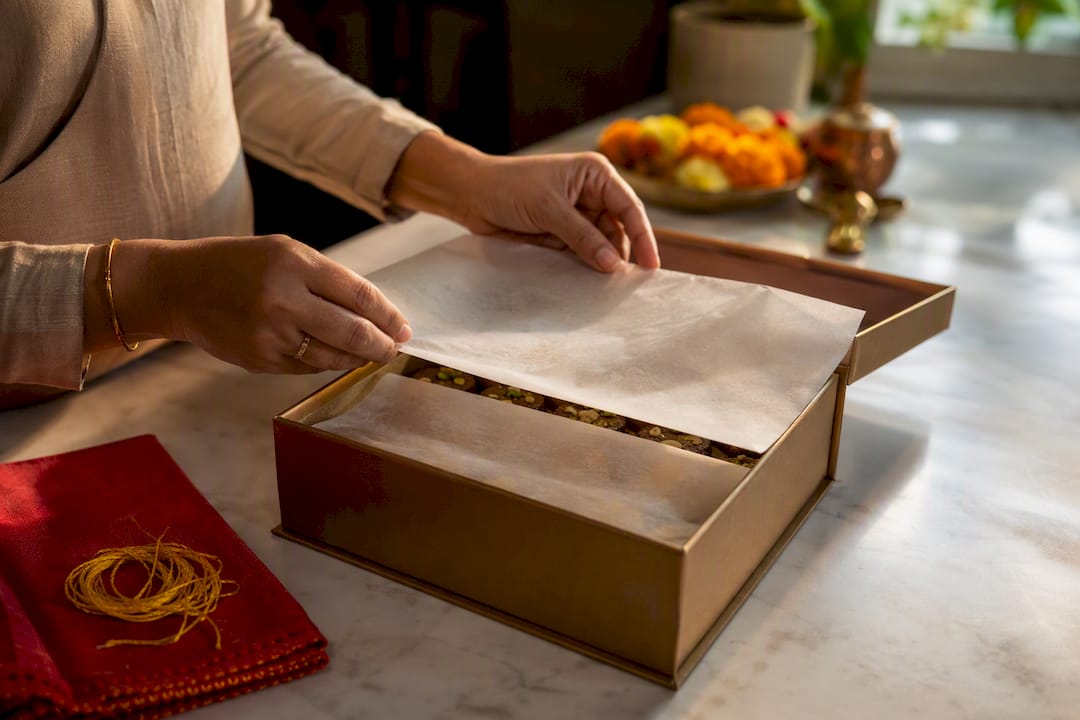
Nine sweets carry most of Diwali: besan ladoo, kaju katli, gulab jamun, jalebi, milk barfi, mysore pak, soan papdi, rasgulla, and kheer. This guide gives you real recipes for each, the technique cues that separate a good batch from a grainy or burnt one, how long everything actually keeps, and how to pack sweets for gifting without a mess. This guide is built with attention to the small steps everyone skips, emphasizing freshness in preparation.
TL;DR:
Most dry, no-cook sweets like chikki and dry-fruit barfi can last up to four weeks at room temperature and are ideal for shipping.
Preparing ladoos requires careful roasting of besan or semolina to avoid raw or burnt flavors, with storage lasting about two weeks if properly sealed.
Syrup-based sweets like jalebi and gulab jamun need precise temperature control during frying and syrup consistency for proper soaking and texture.
Make ahead the shelf-stable items up to a week in advance, while fried and fresh desserts like jalebi and kheer are best prepared on the celebration day.
For those pressed for time or avoiding cooking, ordering handcrafted sweets online ensures freshness and authentic taste, especially for milk-based treats with limited shipping windows.
Table of Contents
Diwali Sweets Guide: The Shortlist by Use Case
Not every sweet earns a spot on a busy prep table. Some are built for mailing across the country; others taste best eaten warm within the hour. Sorting your Diwali sweets list by purpose saves you from making six things that all need the fridge on the same day.
Best for gifting (they travel and hold up):
Kaju katli — Cashew fudge with a smooth, almost porcelain finish. Difficulty: moderate. It keeps well at room temperature when stored in an airtight box.
Soan papdi — Flaky, thread-like sweet that’s mostly assembly, not cooking. Difficulty: easy. It stays fresh for a few weeks when kept dry.
Chikki — Peanut or sesame brittle set with jaggery. Difficulty: easy. It remains good for several weeks if stored properly in a sealed jar.
Dry-fruit barfi — No-cook, date-and-nut based. Difficulty: easy. This sweet keeps well at room temperature and lasts longer when refrigerated.
Best for make-ahead (batch it days early):
Besan ladoo — Roasted chickpea flour rounds. Difficulty: moderate. These ladoos keep for a period when stored properly at room temperature or refrigerated.
Mysore pak — Ghee-rich gram flour fudge. Difficulty: moderate to hard. It is best enjoyed within several days when stored at room temperature.
Rava ladoo — Semolina and coconut, quick to assemble. Difficulty: easy. It stays fresh for a reasonable time when stored properly.
Best served warm, the same day:
Gulab jamun — Fried milk-solid balls soaked in syrup. Difficulty: moderate. Best eaten fresh but can be refrigerated safely for a few days.
Jalebi — Crisp, syrup-soaked spirals. Difficulty: hard, needs practice. This sweet is best served fresh soon after preparation as texture changes quickly.
Kheer — Rice or vermicelli milk pudding. Difficulty: easy. It should be refrigerated promptly and consumed within a few days.
Recipe roundups consistently group Diwali sweets into these preparation categories, and that grouping is exactly why planning by method, rather than by name, makes a Diwali sweets list less overwhelming to cook through. If you’re mapping out a full spread, traditional Diwali mithai tends to split cleanly between what needs a stove and what just needs a mixing bowl and patience.
How Do You Make Perfect Ladoos at Home?
Ladoos are the most forgiving entry point into Diwali sweets, and also the easiest to get slightly wrong. The difference between a ladoo that holds its shape and one that crumbles usually comes down to one thing: roasting time.
Besan ladoo, step by step:
Melt ghee in a heavy pan, add besan (chickpea flour), and roast on low heat, stirring constantly for 15 to 20 minutes.
Watch for the color to shift from pale yellow to a warm golden tone, and listen for the sizzle to quiet down. That’s your cue it’s close.
Pull the pan off heat the moment the aroma turns nutty. Waiting even two extra minutes past that point risks a burnt, bitter batch.
Cool the mixture for 10 minutes, then mix in powdered sugar and roll into rounds while it’s still warm enough to bind.
Rava ladoo swaps besan for roasted semolina and grated coconut, cooked briefly in ghee with milk to bind. It comes together in half the time of besan ladoo since semolina roasts faster and forgives a slightly uneven flame.
Common mistakes: rolling the mixture too hot (it won’t hold), rolling it too cold (it cracks), and under roasting the besan, which leaves a raw, chalky aftertaste that no amount of sugar fixes.
Pro Tip: Roast besan a shade darker than you think you need. It keeps cooking slightly from residual pan heat even after you turn off the stove, and underdone besan is the single most common ladoo complaint.
For storage, cool ladoos fully before boxing them; sealing warm ladoos traps moisture and shortens shelf life by days. Layer with parchment in an airtight tin and they’ll hold for about two weeks at room temperature.
What’s the Secret to Smooth Kaju Katli and Milk Barfi?
Kaju katli’s entire reputation rests on texture. Grainy kaju katli usually means the sugar syrup was cooked too far or the cashew paste wasn’t fine enough before it hit the pan.
To fix graininess, grind soaked cashews into a completely smooth paste (a few seconds too short in the blender shows up immediately as grit in the final fudge). Cook sugar with a little water to a single thread consistency, fold in the cashew paste, and cook on low until the mixture pulls away from the pan sides cleanly. Overcooking past that point is what turns silky katli into a crumbly, sugary block.
Milk-based barfi vs. milk-powder shortcuts:
Traditional khoya barfi reduces whole milk for hours until it thickens into khoya, then sets with sugar and cardamom. It has a denser, richer bite, but takes real time.
Milk-powder barfi condenses that process into 20 minutes by combining milk powder, condensed milk, and ghee over low heat. The flavor is close, texture slightly softer.
Dry-fruit barfi skips the stove almost entirely: dates, almonds, and pistachios are blended and pressed into a slab, then chilled to set.
For quick gifting when time is short, the no-cook dry-fruit route wins. It travels and stores better than milk-based sweets, which matters if you’re mailing a box rather than handing it over the same evening.
Cut barfi only after it’s fully set and cooled, using a greased knife for clean edges. Store in a single layer between parchment sheets so pieces don’t fuse together in transit.
How Do You Make Kheer and Halwa for a Crowd?
Kheer and halwa share one trait: both depend on ratio more than skill. Get the liquid-to-solid balance right and the rest is just patience at the stove.
Basic rice kheer runs on roughly 1/4 cup rice to 4 cups whole milk, simmered on low for 30 to 40 minutes until it thickens and the rice softens completely. Stir occasionally so it doesn’t catch on the pan bottom. Almond (badam) kheer swaps in ground almonds and a shorter simmer, since almond paste thickens milk faster than rice starch does.
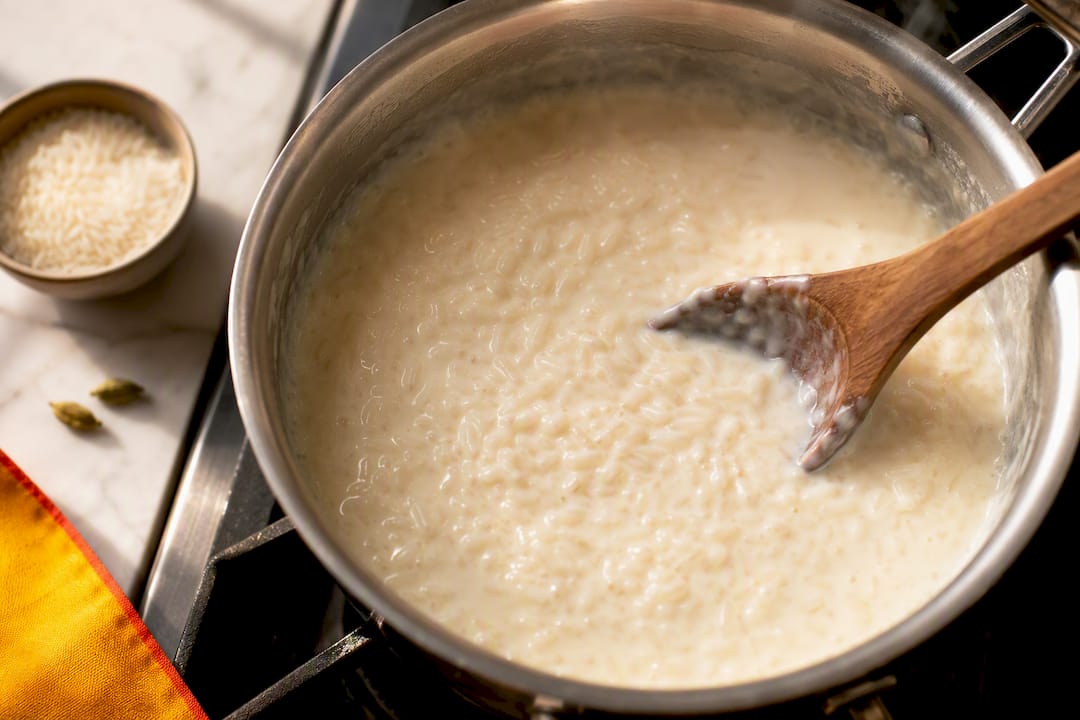
Suji halwa (sheera) starts with roasting semolina in ghee until it turns a light golden color and smells toasted, then hot water or milk gets added off heat in a slow stream to avoid lumps. Sugar and cardamom go in last, and the halwa is done when it pulls together into a glossy mass that releases from the pan sides. Regional versions vary: some cooks fold in mashed banana or pineapple for a fruitier take served at celebrations across western India.
Scaling for groups:
Double the liquid and solids proportionally, but increase simmer time only slightly, since a wider pan surface actually speeds evaporation.
Use a wider, shallower pot for batches over 8 servings; a deep pot risks scorching the bottom before the top thickens.
Serve kheer warm or chilled; both are traditional, so let your event’s timing decide.
Kheer doesn’t survive room temperature past a couple of hours and is featured among milk-based dessert variations common in Indian cultural serving contexts. Refrigerate it promptly and it holds for 2 to 3 days, though the texture firms up and needs a splash of warm milk stirred in before serving again.
Mastering Gulab Jamun and Jalebi: Syrup and Frying Guide
Fried, syrup-soaked sweets scare off more home cooks than any other Diwali sweets category, mostly because two things have to land at once: the syrup consistency and the frying temperature. Get either wrong and the sweet either stays hard or turns greasy.
Syrup stages matter more than people think. A proper one-string syrup means when you pinch a drop between two fingers and pull apart, it forms a single continuous thread. Undercooked syrup stays watery and never soaks in; overcooked syrup crystallizes and turns the whole batch grainy and stiff.
Gulab jamun, technique notes:
Knead the khoya (or milk powder mixture) dough gently, just until it comes together. Overworking it creates dense, rubbery balls.
Shape smooth, crack-free balls; any seam or crack will split open in hot oil and soak unevenly.
Fry on medium-low heat, around 300°F. Too hot and the outside browns before the inside cooks; too cool and the balls absorb excess oil and turn dense.
Drop fried jamuns into warm (not boiling) syrup so they soak evenly without breaking apart.
Jalebi, technique notes:
The batter needs a pourable, slightly thick consistency, similar to pancake batter, so it holds a spiral shape when piped into oil.
Fermenting the batter for a few hours (or adding a pinch of yeast for a shortcut) gives jalebi its signature light crunch.
Fry at a slightly higher heat than jamun, closer to 350°F, so the spirals crisp fast without soaking up too much oil.
Pro Tip: Test your syrup and oil before committing the whole batch. Fry one jamun or pipe one jalebi first. If it doesn’t hold shape or soak right, adjust before you’ve ruined a full tray.
Which Diwali Sweets Skip the Stove Entirely?
Not every sweet needs a burner, and that’s good news on a week when you’re juggling five other recipes at once. No-cook and dry sweets are the backbone of any solid Diwali gifting sweets plan because they hold up in transit.
Soan papdi looks intricate but is mostly assembly: layered sugar syrup threads folded with roasted gram flour and ghee, then pressed and cut into cubes. Store it in a completely airtight container, since it absorbs humidity fast and turns sticky within a day if exposed to air.
Chikki sets by pouring hot jaggery or sugar syrup over roasted peanuts or sesame seeds, then flattening and cracking into pieces once cool. It holds up especially well for shipping, since there’s no moisture to leak or refrigeration required.
Dry-fruit barfi (dates, nuts, sometimes coconut) needs only a food processor and a chilled tray to set. It’s the fastest sweet on this whole Diwali snacks list, start to finish, often under 30 minutes.
For gifting boxes headed across the country, prioritize these three over anything syrup-soaked or milk-based. Wrap each piece individually in wax paper before boxing, and add a layer of parchment between rows so pieces don’t stick together during transit.
What Savory Snacks Pair With Diwali Sweets?
A table of only sweets gets tiring fast, which is exactly why Diwali spreads always include faral, the savory counterpart. Traditional Diwali snacks lean crunchy and spiced, cutting through the sugar between bites.
Classic jar snacks include chakli (spiral rice-flour crisps), namak para (diamond-cut fried pastry), chivda (a spiced flattened-rice mix), and sev (thin gram flour noodles). Hot, fresh-fried options like kachori or samosas round things out for guests arriving later in the evening. Savory faral snacks are a customary part of Diwali specifically because they balance the richness of ladoo, barfi, and syrup sweets.
A good rule of thumb: for every three sweets on the table, include at least one savory. Most jar snacks like chivda and namak para keep for two to three weeks in an airtight container, so they’re easy to make well ahead of the holiday rush. If you want more structured ideas, this rundown of festival-exclusive Indian snacks covers a few worth adding to the mix.
When Should You Make Each Diwali Sweet?
Timing is where most home cooks lose control of their Diwali prep. Working backward from the day of celebration keeps you from a last-minute scramble.
7 days before: Make anything shelf-stable and dry, chikki, soan papdi, dry-fruit barfi, and besan ladoo. These only improve as flavors settle.
3 days before: Make mysore pak and kaju katli. Both need full cooling and setting time, and they hold their texture well over a few days.
1 day before: Prep gulab jamun dough and jalebi batter (letting jalebi batter ferment overnight actually helps the texture).
Day of: Fry gulab jamun, fry jalebi, and cook kheer fresh. These taste best within hours of being made and don’t reheat gracefully.
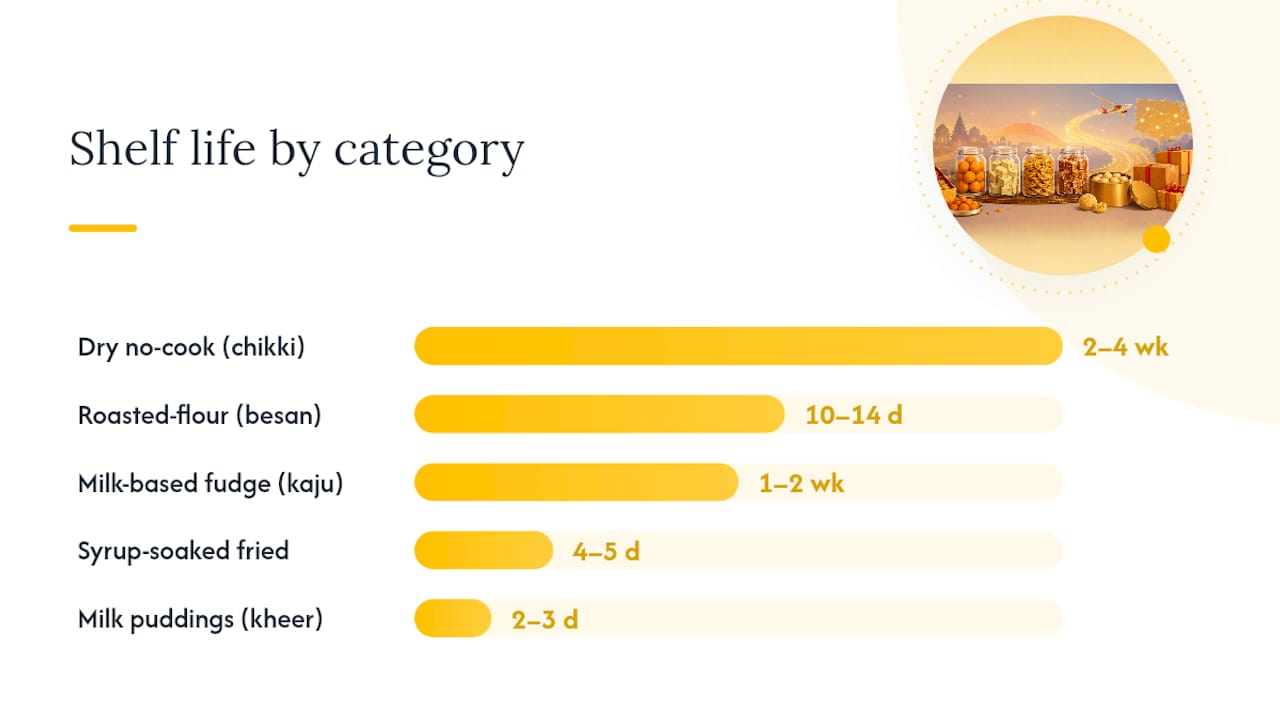
Shelf life by category:
Dry, no-cook sweets (chikki, dry-fruit barfi, soan papdi): 2 to 4 weeks at room temperature.
Roasted flour sweets (besan ladoo, rava ladoo): 10 days to 2 weeks room temperature, up to a month refrigerated.
Milk-based fudge (kaju katli, milk barfi, mysore pak): 1 to 2 weeks room temperature.
Syrup-soaked fried sweets (gulab jamun, jalebi): 4 to 5 days refrigerated, best within 2 days.
Milk puddings (kheer, payasam): 2 to 3 days refrigerated only, never room temperature past a couple of hours.
Recipe guides broadly agree that dry sweets and barfi keep longer at room temperature while milk-based and syrup sweets need refrigeration once they’re a few days old.
For gifting, pack sweets in a rigid box with a layer of parchment or wax paper between rows, and separate different sweet types so flavors and moisture don’t transfer. If you’re shipping across the US, add an insulated liner for anything milk-based and skip syrup sweets entirely unless the trip is under a day. For local, no-shipping gifts, ordering sweets online with a set delivery window solves the timing problem outright.
Where to Source Ingredients and Swap for Dietary Needs
Ghee, khoya, and jaggery aren’t always sitting on a regular grocery shelf, but they’re not hard to find either. Indian grocery stores stock all three, along with khoya substitutes like milk powder blends, and most now sell online with nationwide shipping if there isn’t a store nearby.
Vegan swaps that actually work:
Replace ghee with plant-based butter or a neutral oil like coconut oil. The flavor shifts noticeably, so add a touch more cardamom or a pinch of saffron to compensate for the lost richness ghee normally brings.
Swap milk-based khoya for a coconut milk reduction or vegan condensed milk in barfi and ladoo recipes.
Lower the stovetop heat slightly when using plant butter instead of ghee. It has a lower smoke point and burns faster than ghee does.
Nut allergies rule out kaju katli, most barfi, and chikki as written, but sesame chikki and coconut-based barfi are easy substitutes that keep the texture and sweetness readers expect without a single nut in the ingredient list.
If you’re stocking up for a full Diwali spread, buying Indian sweets and ingredients online is often faster than driving to three different stores for ghee, khoya, and jaggery separately. For a deeper look at vegan-specific recipes, freshly made vegan Indian sweets covers which ones adapt best and which don’t.
Troubleshooting Cheat Sheet for Diwali Sweets
Every Diwali sweet has its own failure point, but most problems trace back to one of three things: syrup temperature, roasting time, or frying heat.
Syrup crystallizing? You likely stirred it after it started boiling. Once sugar syrup hits a rolling boil, leave it alone; stirring encourages crystals to form.
Ladoo mixture too dry or crumbly? Add a spoon of warm ghee or milk while it’s still warm, and re-roll immediately.
Barfi came out grainy? The sugar syrup overcooked past one-string stage. Next batch, pull it earlier and test more often near the end.
Burnt besan? There’s no fixing scorched flour; discard and restart on lower heat, stirring more frequently this time.
Gulab jamun turned hard or dense? The dough was overworked, or the oil was too hot. Knead less next time and drop the frying temperature by about 20 degrees.
Jalebi came out soggy instead of crisp? The syrup was too hot when the fried spirals went in. Let syrup cool slightly to warm, not boiling, before soaking.
Sweets taste too sweet overall? Cut sugar by 10 to 15 percent next batch. Most recipes are calibrated for Indian palates accustomed to more sugar than some US-based readers prefer.
For frying specifically, keep oil between 300°F and 350°F depending on the sweet, and never reuse oil more than twice for delicate items like jalebi, since repeated heating darkens the flavor and lowers the smoke point.
Pro Tip: Keep a small bowl of water nearby when testing syrup stage. A drop that firms into a soft ball on contact with cold water means you’ve gone past one-string and into a different sweet’s syrup entirely.
Technique guides consistently point to one-string syrup and aromatic besan roasting as the two checkpoints that decide whether a batch succeeds, and that lines up with what most home kitchens run into. For a broader technique primer beyond sweets, traditional Indian snack-making methods covers roasting and frying fundamentals that carry over directly.
Sample Diwali Menus for 6, 20, and 50+ Guests
Planning a spread gets easier once you stop thinking “how many sweets” and start thinking “how many categories.”
Small gathering (6 guests): One ladoo (besan or rava), one barfi (kaju katli or milk barfi), one no-cook sweet (dry-fruit barfi), and one savory (chivda). Four items, minimal stovetop time.
Medium party (20 guests): Add gulab jamun and a kheer to the small list above, plus a second savory like namak para. Six items total, spread across the 7/3/1 day prep schedule.
Large celebration (50+ guests): Full lineup, besan ladoo, mysore pak, kaju katli, soan papdi, gulab jamun, jalebi, kheer, plus two to three savories. Batch-cook dry sweets a week out and reserve day-of energy for fried items only.
Shopping checklist: ghee, besan, semolina, milk powder or khoya, sugar, jaggery, cardamom, saffron, nuts (cashew, almond, pistachio), and frying oil. Equipment: a heavy-bottomed pan, a candy thermometer if you’re not confident testing syrup by hand, and airtight tins for storage.
Are Any Diwali Sweets Actually Healthy?
Most Diwali sweets run high in sugar and ghee by design; that’s the point of a festival dessert, not a flaw to fix. Still, some choices carry more nutritional value than others.
Dry-fruit barfi made from dates, almonds, and cashews delivers fiber, healthy fats, and micronutrients like magnesium and vitamin E alongside the sweetness, unlike sugar-syrup sweets that offer mostly calories with little else. Nut-based sweets in general trade some sugar for protein and unsaturated fat, which is a meaningfully different nutritional profile than jalebi or gulab jamun, both of which are essentially fried dough saturated in sugar syrup.
Portion size matters more than ingredient swaps for most people. A single piece of kaju katli or besan ladoo, eaten mindfully, fits into most diets during a festival week without issue. The problem comes from grazing on five different sweets across several days without noticing the total.
For genuinely lighter options, look toward kheer made with reduced sugar and skim milk, or roasted (not fried) versions of traditional recipes. Jaggery, used in chikki and some ladoo variations, carries trace minerals that refined sugar lacks, though it’s still sugar and should be treated as such nutritionally. Anyone managing blood sugar closely should treat every syrup-soaked sweet as an occasional indulgence rather than a daily one, and talk to a doctor about portioning if diabetes is a concern.
Why Do Sweets Matter So Much at Diwali?
Diwali marks the return of Lord Rama to Ayodhya after 14 years of exile, and the homes that lit lamps to welcome him back also fed him, because in most Indian households, celebration and food have never been separate acts. Sweets specifically carry the symbolism of shakkar and mithai as offerings of prosperity and good fortune, shared with neighbors and family to spread the year’s luck around rather than hoard it.
That’s part of why gifting sweets during Diwali isn’t an afterthought; it’s the point. A box of ladoo or barfi handed to a neighbor is a small ritual repeated across millions of households, tying a private family kitchen to a much wider community. Many families have a specific sweet tied to their region or lineage passed down for generations, which is part of why one household’s kaju katli recipe tastes distinct from another’s despite using nearly identical ingredients.
The preparation itself carries weight too. Making sweets from scratch, roasting the besan slowly, watching syrup for its exact stage, has traditionally been treated as an act of devotion as much as cooking. Rushed, store-bought shortcuts have their place in a busy modern year, but the ritual of making at least one sweet by hand is something a lot of home cooks say keeps the holiday feeling like Diwali rather than just another dessert night.
Regional Diwali Sweets Worth Trying Beyond the Basics
India’s Diwali sweets list doesn’t stop at ladoo and barfi. Regional traditions bring genuinely different textures and flavors to the table, and a few are worth adding to your rotation if you want variety beyond the usual suspects.
Bengali sandesh uses fresh chhena (curdled milk paneer-like curd) rather than khoya, giving it a lighter, almost cheesecake-like crumble instead of the dense fudge texture common in North Indian sweets. It’s typically less sweet, letting the milk flavor come through more clearly.
Punjabi ghewar is a disc-shaped, honeycomb-textured fried sweet made from a thin batter poured into hot ghee in careful layers, then soaked in sugar syrup and topped with rabri (thickened, sweetened milk) or nuts. It takes real practice to get the layered structure right, so it’s more often bought than made at home.
South Indian mysore pak hails from Karnataka and leans heavily on ghee for its shine and melt-in-the-mouth texture, distinct from the drier, crumblier barfi found further north.
Maharashtrian karanji resembles a fried, sweet-filled dumpling, stuffed with coconut, jaggery, and nuts, closer to a hand pie than a fudge or ladoo.
Trying even one regional sweet outside your usual list adds real range to a Diwali spread, and gives guests something to talk about beyond the expected lineup.
A Home Cook’s Honest Take on Diwali Sweets
Most guides treat Diwali sweets like a checklist to clear before the big day. I think that’s backward. The sweets that actually matter are the ones you make with someone else in the kitchen, not the ones that photograph best on a gifting tray.
Here’s what conventional advice underestimates: the fear of failure stops more home cooks from attempting gulab jamun or jalebi than any real difficulty in the recipes themselves. Syrup consistency and frying temperature are learnable in one afternoon of practice. What isn’t learnable in an afternoon is patience, and that’s the actual skill these sweets demand.
I’d also push back on the idea that homemade always beats store-bought. If your week is packed and the choice is between rushed, undercooked jamun or a fresh batch from a maker who does this daily, take the second option and spend your saved time on the sweet you actually want to make by hand. There are options for freshly made, handcrafted sweets for the days you can’t do it all yourself. [Author bio for Shivam] [Desimunchiess proof points placeholder]
That’s the real lesson from a decade of Diwali kitchens: pick your battles, master one or two sweets properly, and let the rest come from someone who’s already mastered them.
— Shivam
Order Fresh Diwali Sweets Without the Kitchen Marathon
There are services that provide fresh, handcrafted mithai made with traditional recipes and real ingredients, including vegan options, for those who prefer not to make them at home.
If you’re planning to gift sweets across the country this Diwali, order early. Shelf-stable options ship well, but anything milk-based needs a shorter transit window, so build in a few extra days before the celebration date rather than ordering the week of. Order Indian sweets online and pick a delivery date that gives your gift box time to arrive fresh, whether it’s headed to your own table or a neighbor’s.
Sources
For readers who want full recipe measurements and step-by-step photos beyond this guide, a few collections stand out. Traditional and modern Diwali sweet recipes offers detailed category breakdowns by preparation method. Diwali snacks and savory recipes covers the faral side of the table in depth. Ladoo, mysore pak, and classic mithai guides break down difficulty levels clearly for beginners. Easy, shippable Diwali mithai focuses specifically on gifting-friendly, shelf-stable options.
Recommended
Comments