
Jaggery vs Sugar: An Evidence-Based Health Guide
- DesiMunchiess

- Aug 15
- 11 min read
Jaggery is marginally more nutritious than refined white sugar, but it is not a low-calorie or blood-sugar-safe alternative. Swap for swap, jaggery edges ahead because it retains trace minerals like iron, potassium, and magnesium that refining strips away. The catch? Research published on ResearchGate reports jaggery’s glycemic index at 84–84.4, higher than white sugar’s roughly 65, meaning it can raise blood glucose faster in some people. The mineral advantage is real but modest at realistic serving sizes. People with diabetes, insulin resistance, or prediabetes should treat jaggery with the same caution as sugar, limiting or avoiding its use. For metabolically healthy adults who love bold, traditional flavors, a small swap can be a meaningful cultural and culinary choice, just not a therapeutic one.
Jaggery contains trace iron, potassium, and magnesium; refined white sugar contains essentially none.
Both sweeteners deliver a similar number of calories per 100 g.
Jaggery’s glycemic index may exceed white sugar’s, meaning it can raise blood glucose faster in some people.
Neither is safe in large amounts for people managing blood sugar.
Key Takeaways
Jaggery edges ahead of refined white sugar nutritionally, but its higher glycemic index means it is not a safer option for blood sugar management and should be used in the same small amounts as any added sweetener.
Point | Details |
Jaggery has trace minerals | It retains iron, potassium, and magnesium that refining removes, but amounts per teaspoon are small. |
GI is higher than white sugar | Jaggery’s reported GI of 84–84.4 exceeds white sugar’s ~65, meaning faster blood glucose rises. |
Calories are nearly identical | Both sweeteners deliver roughly 380–387 calories per 100 g; swapping does not reduce caloric intake. |
Diabetics should not swap freely | Jaggery raises blood sugar and is not a clinically safe substitute for people with diabetes or insulin resistance. |
Use in moderation | Stick to 1–2 teaspoons per serving and count it toward your daily added sugar limit. |
Table of Contents
What are jaggery and sugar, and where do they come from?
Jaggery is an unrefined sweetener made by concentrating sugarcane juice or palm sap without separating the molasses. That retained molasses is what gives jaggery its deep, caramel-like color and earthy flavor, and it is also the source of its trace minerals. Across South Asia and parts of Africa, jaggery goes by many names: gur in Hindi and Punjabi, bellam in Telugu, vellam in Tamil, and gud in Marathi. It is produced in India, Pakistan, Bangladesh, Sri Lanka, and across West Africa, often in small-batch operations using traditional methods.
Refined white sugar is almost pure sucrose, typically derived from sugarcane or sugar beets. Industrial processing removes the molasses entirely, leaving a product that is consistent, shelf-stable, and flavor-neutral, but nutritionally bare beyond calories and carbohydrates.
Common forms you will find in stores:
Jaggery: solid blocks, soft paste, and increasingly, granulated or powdered forms sold in Indian and South Asian grocery stores across the U.S.
White sugar: fine granules, powdered, and cubes; the global standard sweetener.
Brown sugar: refined white sugar with a small amount of molasses added back, making it closer to jaggery in color but not in composition or processing.
Brown sugar and jaggery are often confused, but they are not the same. Brown sugar is a refined product with controlled molasses re-addition; jaggery is never refined in the first place.
How jaggery and refined sugar are made, and why processing matters
The production gap between jaggery and refined sugar is significant, and it explains nearly every nutritional difference between them.
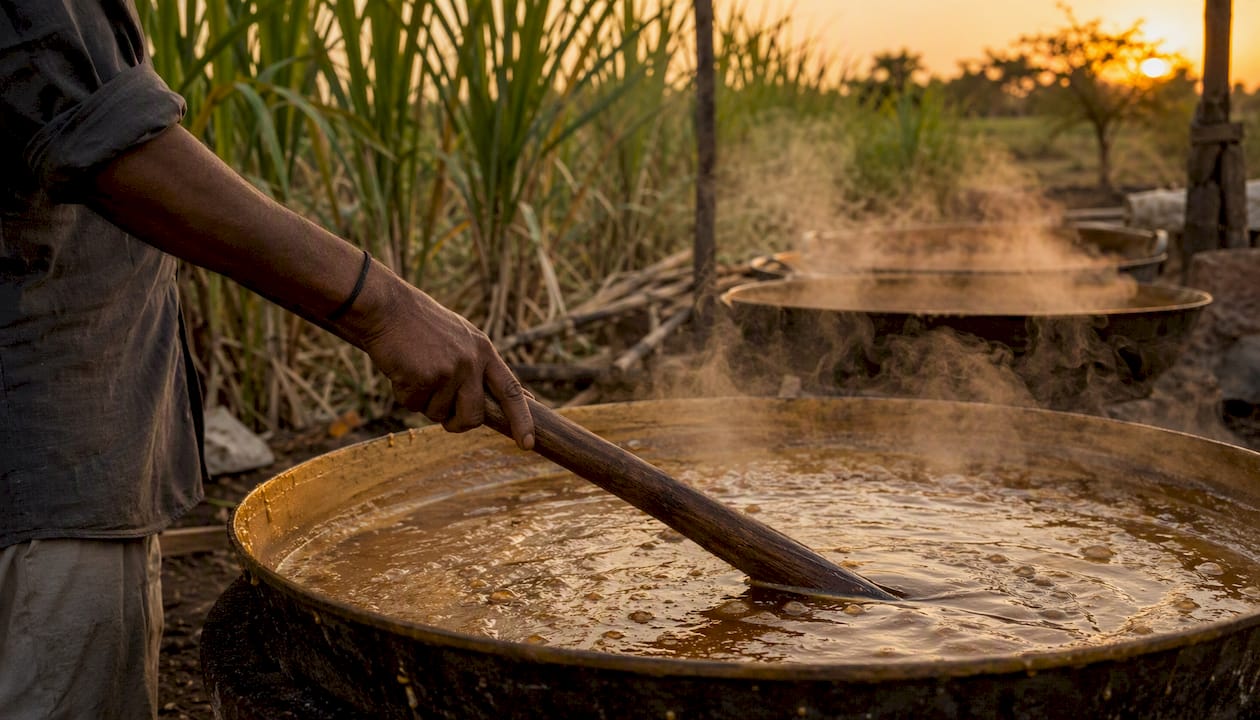
Jaggery production starts with pressing sugarcane or tapping palm trees to collect raw juice. That juice is boiled in large open pans, skimmed of impurities, and stirred continuously as it thickens. Once it reaches the right consistency, it is poured into molds and cooled. No centrifuge, no bleaching, no chemical clarification. The molasses stays in. So do the minerals and a portion of the antioxidants naturally present in the raw juice.
Refined sugar production runs through several additional steps: the raw juice is clarified with lime, filtered, spun in a centrifuge to separate sucrose crystals from molasses, then bleached and dried. A peer-reviewed food science study in PMC confirmed that jaggery’s differing composition directly affects how baked products behave, including pasting properties, texture, and moisture retention, compared to refined sugar.
The flavor difference follows directly from processing. Jaggery carries notes of caramel, toffee, and sometimes smoke or earthiness depending on the source. White sugar is flavor-neutral, which is why it is the default in most Western baking.
Pro Tip: When buying jaggery, look for a deep golden-brown to dark brown color and a firm, dry texture. Pale or overly soft jaggery may indicate adulteration with refined sugar or excessive moisture. In the U.S., check South Asian grocery stores or trusted online retailers, and look for single-ingredient labels that list only “sugarcane juice” or “palm sap.”
How do jaggery and sugar compare nutritionally?
The honest answer: the differences are real but small at the amounts most people actually use. USDA FoodData Central is the authoritative source for per-100 g nutrient values, and it shows both sweeteners are calorie-dense with high carbohydrate content.
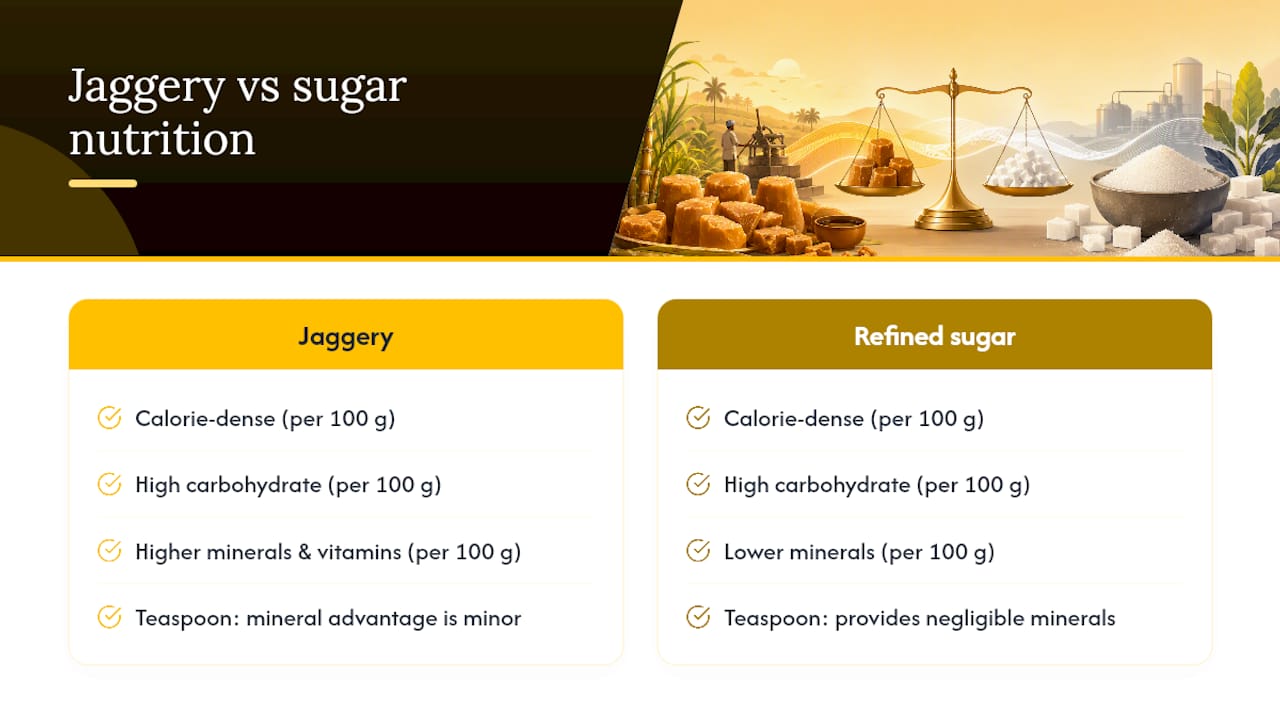
(Per-100 g values; jaggery figures vary by source and processing method.)
The mineral numbers look impressive at 100 g. The problem is that nobody eats 100 g of sweetener in a sitting. A single teaspoon of jaggery weighs roughly a few grams, delivering a small number of calories and a fraction of a milligram of iron. Medical News Today notes that while jaggery does contain small amounts of vitamins and minerals, the amounts at realistic serving sizes are limited, and the product remains high-calorie and blood-glucose raising.
The bottom line on nutrition: at a teaspoon level, jaggery’s mineral advantage over white sugar is real but nutritionally minor. You would need to eat an impractically large amount to meet even a modest percentage of your daily iron needs from jaggery alone.
How does each sweetener affect your blood sugar?
This is where the jaggery-is-healthier narrative gets complicated. Glycemic index (GI) measures how fast a food raises blood glucose compared to pure glucose (GI = 100). A lower GI means a slower, more gradual rise.
The ResearchGate review synthesizing multiple studies reports jaggery’s GI at 84–84.4, compared to white sugar’s approximately 65. That is a meaningful gap in the wrong direction for anyone watching blood glucose.
Glycemic load (GL) adjusts for serving size. At one teaspoon, both sweeteners have a low glycemic load simply because the quantity is small. The real-world risk comes from cumulative use: multiple cups of chai sweetened with jaggery, jaggery-based sweets eaten as snacks, or jaggery stirred into sauces throughout the day.
Key implications by population:
Metabolically healthy adults: a teaspoon of jaggery in tea or cooking is unlikely to cause harm and offers a trace mineral bonus over white sugar.
People with prediabetes: the higher GI warrants caution; jaggery is not a safer swap and may spike blood glucose faster than expected.
People with type 2 diabetes: News18’s fact-check summarizes expert consensus clearly: jaggery raises blood sugar and is not a safe substitute for diabetics.
Children and adolescents: both sweeteners contribute to dental caries and excess caloric intake; neither should be used freely.
Jaggery’s GI of 84–84.4 is higher than white sugar’s ~65, meaning it can produce a faster postprandial glucose rise. This directly counters the widespread belief that jaggery is a “safer” sweetener for blood sugar management.
What health benefits does jaggery actually have?
Jaggery carries a strong health halo in traditional medicine and popular wellness culture. Some of those claims have a real, if modest, evidence base. Others are overstated.
Claims with some support:
Trace mineral content: Healthline confirms that jaggery retains molasses and provides trace iron, magnesium, and potassium. These are real nutrients. The caveat is that the amounts per teaspoon are small, and dietitians consistently advise getting minerals from whole foods like legumes, leafy greens, and seeds rather than from a sweetener.
Antioxidant activity: Molasses-containing sweeteners do carry measurable antioxidant markers, as documented in PMC research on antioxidant properties of unrefined sweeteners. Whether these amounts translate to a clinical benefit at normal serving sizes has not been established in human trials.
Digestive use in traditional practice: Jaggery is traditionally consumed after meals in parts of India as a digestive aid. There is limited clinical evidence for this specific effect; it remains a cultural practice with anecdotal support rather than a proven therapeutic claim.
Claims that are overstated:
Anemia prevention: The iron in jaggery is real, but the serving sizes needed to make a dent in daily iron requirements are unrealistic. A registered dietitian would not recommend jaggery as an iron source.
Detoxification: No peer-reviewed clinical evidence supports jaggery as a detox agent. This claim circulates widely in wellness content but lacks scientific backing.
Weight management: Jaggery and white sugar are nearly identical in caloric density. Swapping one for the other does not support weight loss.
“The extra nutrients in jaggery don’t justify eating large amounts. You should still consume it in moderation.” This framing from Healthline captures the consensus position across registered dietitians and reputable health outlets.
Who should be careful with jaggery, and what are the risks?
Both sweeteners carry the same core risks: caloric density, blood sugar elevation, and contribution to dental caries. Jaggery adds a few specific concerns worth knowing.
Shared risks (jaggery and white sugar):
High caloric density (~380–387 kcal per 100 g) contributes to weight gain when consumed in excess.
Both promote dental caries; fermentable sugars feed oral bacteria regardless of how refined the sweetener is.
Excess added sugar from either source is linked to metabolic disease, as documented in PMC epidemiologic reviews.
Jaggery-specific risks:
Higher reported GI (84–84.4) means faster blood glucose spikes compared to white sugar.
Adulteration is a documented concern in some markets; low-quality jaggery may contain added refined sugar, chalk, or other fillers.
Unregulated production in some regions means inconsistent composition and potential contamination.
Who should avoid or strictly limit jaggery:
People with type 2 diabetes or insulin resistance
Anyone on a carbohydrate-restricted diet (keto, low-GI therapeutic diets)
Young infants (no added sugars of any kind)
People with reactive hypoglycemia
Pro Tip: If you are testing jaggery as a new addition to your diet and you monitor blood glucose, check your levels 1–2 hours after consuming it. A continuous glucose monitor (CGM) or a standard glucometer gives you real data on how your body responds, which is far more useful than any population-average GI figure.
How do you substitute jaggery for sugar in recipes?
Jaggery works beautifully in the right recipes and poorly in others. Knowing which is which saves you from a failed bake.
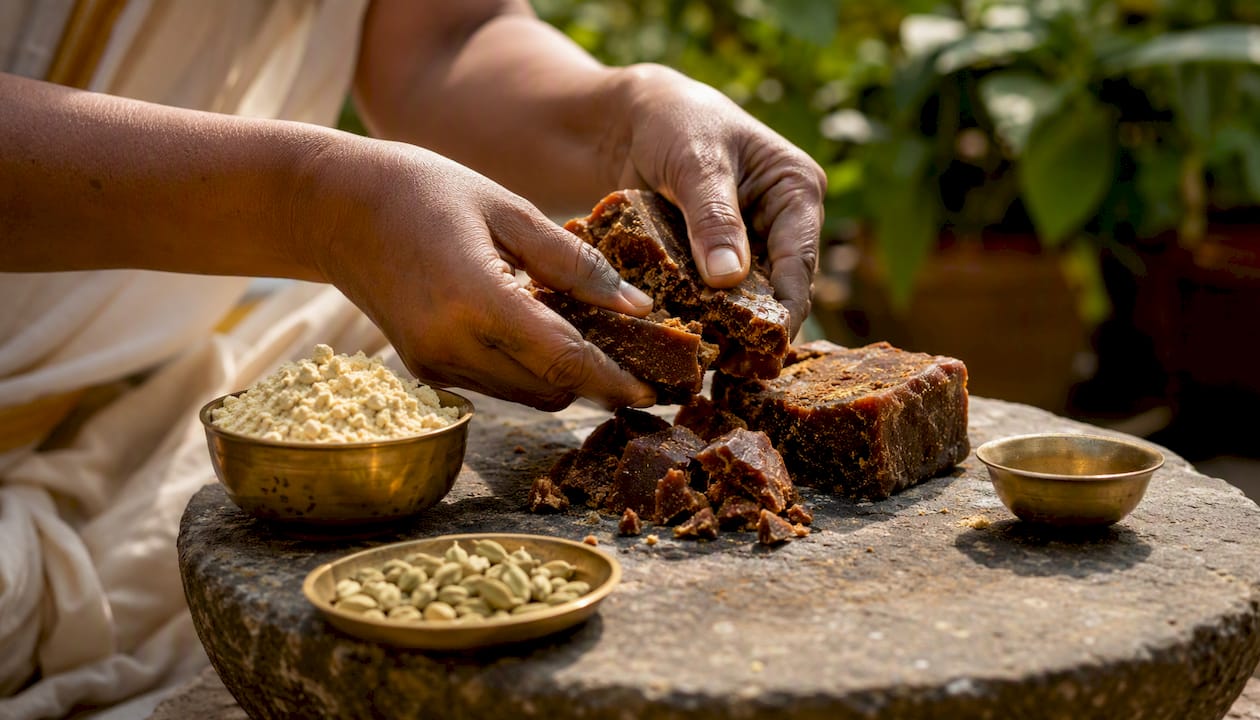
Substitution ratio: Use roughly ¾ cup of jaggery for every 1 cup of white sugar by volume, or substitute 1:1 by weight and adjust sweetness to taste. Jaggery is slightly less sweet than refined sugar in some preparations, though this varies by batch and source.
What changes when you swap:
Color: Jaggery adds a golden-brown to dark color. Light-colored cakes and cookies will look noticeably darker.
Moisture: Jaggery is hygroscopic; it holds more moisture than white sugar. Reduce other liquids in baked goods by about 2–3 tablespoons per cup of jaggery used.
Flavor: Expect caramel, toffee, and earthy notes. This is a feature in chai, halwa, chikki, and many heritage Indian snack recipes, but it can clash with delicate flavors in vanilla sponge cakes or shortbread.
Texture in baking: The PMC muffin study found that jaggery changes pasting properties in wheat flour, affecting crumb structure and moisture retention in baked goods.
Recipes where jaggery shines:
Chai and spiced teas
Chikki (peanut brittle), ladoo, and other traditional Indian sweets
Tamarind-based chutneys and marinades
Oatmeal, overnight oats, and grain porridges
Recipes where white sugar is the better call:
Light sponge cakes and angel food cake (need neutral flavor and aeration)
Meringues and macarons (require pure sucrose behavior)
Pale frostings and glazes
How to prepare jaggery for recipes:
Grate or chop block jaggery into small pieces before measuring.
To melt, combine with a tablespoon of water over low heat and stir until dissolved.
For granulated jaggery, pulse dry pieces in a food processor until fine.
Store unused jaggery in an airtight container away from humidity to prevent clumping.
Troubleshooting checklist:
Baked good too dense? Reduce jaggery moisture by cutting other liquids slightly.
Too dark in color? Use lighter, golden jaggery rather than dark block varieties.
Grainy texture? Melt and strain jaggery before adding to batters.
Flavor too strong? Start with a 50/50 blend of jaggery and white sugar, then adjust.
For readers curious about how traditional Indian snack-making techniques use jaggery in practice, the methods vary significantly by region and recipe type.
What does the research actually say?
The evidence base for jaggery is growing but still limited in clinical depth. Here is where the key sources land:
Study / Source | Type of Evidence | Key Finding |
Food science lab study | Jaggery replacement changes pasting properties, sensory profile, and moisture in baked goods | |
Systematic review | Jaggery GI 84–84.4 vs. white sugar ~65; more minerals and antioxidants, but higher glycemic risk | |
Review article | Antioxidant markers present in molasses-containing sweeteners; excess added sugar linked to metabolic disease | |
Peer-reviewed food science | Compositional analysis of jaggery confirming mineral retention and processing effects |
The pattern across these sources is consistent: jaggery has a real but modest nutritional edge over white sugar, and that edge does not extend to glycemic safety. Most studies are food-science or observational in design. Long-term randomized controlled trials comparing health outcomes in people who use jaggery versus white sugar as their primary sweetener do not yet exist at scale.
The evidence supports jaggery as a slightly more nutritious sweetener, not as a health food. The distinction matters most for people who already have metabolic conditions and may be swapping sweeteners under the assumption that jaggery is safe for blood sugar.
When should you use jaggery, and how much is safe?
Practical rules you can apply today, without overthinking it:
Daily added sugar limits: Most nutrition guidelines recommend limiting added sugar intake to low amounts per day. Jaggery counts fully toward that limit, the same as white sugar.
Serving size target: One to two teaspoons per serving (4–10 g) is a reasonable ceiling for most uses. At that level, you get the flavor and a trace mineral bonus without a significant glycemic hit.
Swap guidance: If you currently use white sugar in chai, oatmeal, or traditional sweets, replacing it with an equal amount of jaggery is a reasonable choice for metabolically healthy adults. Do not increase your total sweetener use just because you switched to jaggery.
Shopping tips: Look for jaggery labeled as 100% sugarcane or palm; avoid products with added sugar, artificial color, or preservatives listed on the label. Organic-certified jaggery from reputable South Asian brands tends to have more consistent quality.
Price and availability: Jaggery is widely available in Indian and South Asian grocery stores across the U.S. and through online retailers. Block jaggery is typically less expensive per ounce than granulated versions; powdered jaggery commands a small premium for convenience.
Pro Tip: Pair a small amount of jaggery with a vitamin C-rich food (like a squeeze of lime in chai or amla powder in a smoothie). Vitamin C enhances non-heme iron absorption, which means the trace iron in jaggery becomes slightly more bioavailable. It is a small effect, but it is one of the few ways to make jaggery’s mineral content practically useful without eating more of it.
For readers looking for homemade-style snack swaps that use traditional sweeteners thoughtfully, small amounts of jaggery in the right context can be both delicious and a better choice than processed sugar-laden alternatives.
A note on jaggery from us at Desimunchiess
At Desimunchiess, we grew up with jaggery in the kitchen. It was in the chai, in the chikki, in the halwa our families made on cold mornings. We have deep respect for what it represents: a less processed, more flavorful connection to traditional cooking.
But we also believe in being honest with you. Jaggery is not a superfood. It is a sweetener with a richer story and a slightly better nutritional profile than white sugar, and it deserves to be used the way our grandmothers used it: in small amounts, in recipes where its bold flavor actually belongs, not as a guilt-free license to eat more sweets.
When we craft our snacks and sweets at Desimunchiess, we use traditional sweeteners thoughtfully, because the goal is always real flavor and real quality, not a health claim that does not hold up. If you want to experience what jaggery tastes like in a well-made traditional sweet, our Mango Candy is a good place to start: bold, fresh, and made the way it should be.
Sources
These are the primary sources behind this article. Each one is worth bookmarking if you want to dig deeper.
This article is general information, not a substitute for advice from a qualified doctor. Consult a qualified healthcare professional about your own circumstances before acting on anything here.
Recommended
Comments